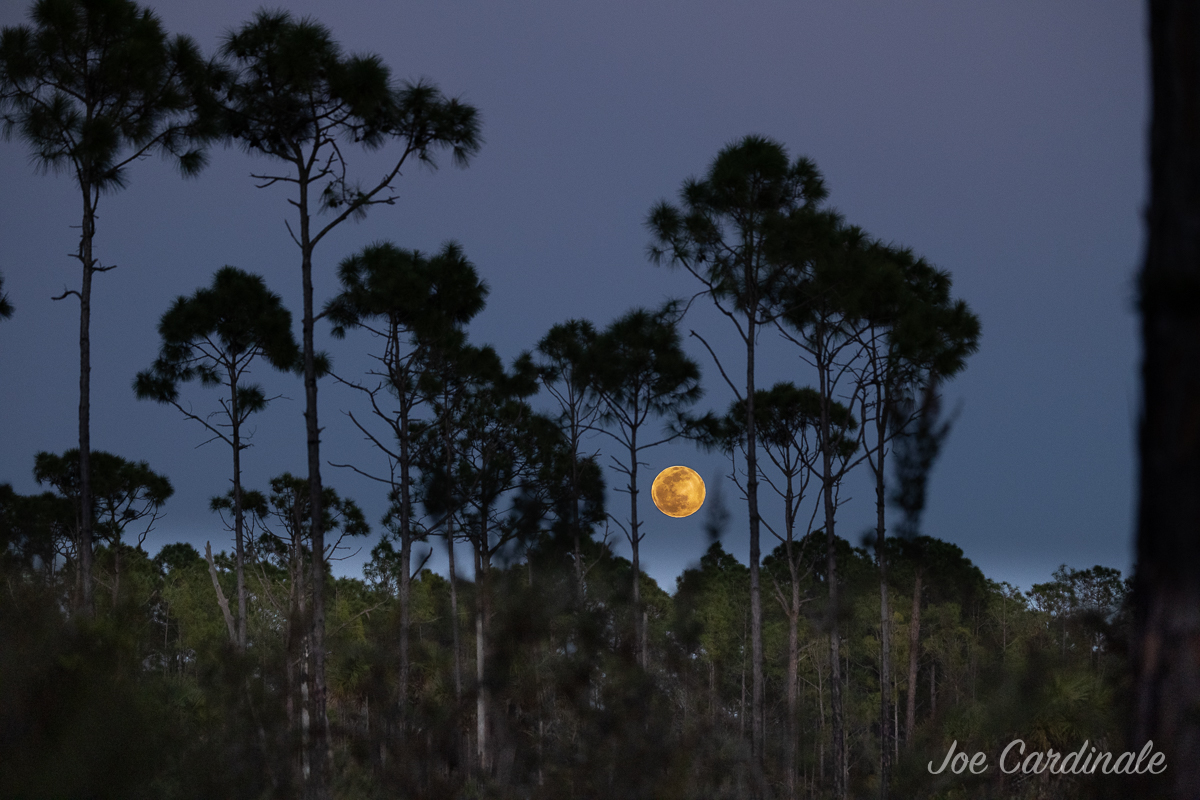
To see, or not see, a panther

Recently I led a group of new volunteers on a training session at the Cypress Dome Trails. My goal was to discuss our volunteer handbook and things to know as a new volunteer as well as engage in conversation so we could get to know each other.

I also wanted them to hike the Wild Coffee Trail, the section of the white trail that few people actually traverse. Why?

Most of the year it is wet. Very wet. And when it isn’t wet, it’s muddy. Not fun muddy, but suck-your-shoe-off-and-taunt-you muddy.

While we were hiking the easier part (after marker 10), I asked our volunteers, “What is the coolest wildlife sighting you’ve had?”

For almost everyone, the answer came very quickly and varied from mammals to reptiles to birds. I have two: a Great Horned Owl that flew very close to my husband and I while we were hiking and completely surprised us, and the Pink Lady’s Slipper, a member of the orchid family that surprised us all by growing one summer in my grandmother’s garden at our cabin in Northern Michigan.

The most common answer, not surprisingly, was the Florida Panther.

A few in our midst had a story to tell about their panther sighting, and for the rest of us, we all expressed how seeing one was definitely on our bucket list.

I myself have yet to see one in real life. I did recently find tracks, right by our mailbox, and they were spectacular.


I sent the photos of the tracks to a volunteer who monitors game cameras near our office, and he emailed a photo taken the evening before I found the tracks of this handsome male panther.

On the short drive home that evening, I was thinking about my excitement and the possibility of seeing my first (living) panther. Surely I would see one soon since I saw the tracks and we have the panther on game camera.

It seems inevitable. Move to SWFL, and you are bound to see panthers. There are signs all over warning of panther crossings (and, no, panthers are not black – please help spread the word).

I’ve heard everything from locals who have waited their whole lives to see a panther to tourists who simply turned a corner in their car and saw one dart across the road.

One of my very wise volunteers often tells people on her guided walks that she has never seen a panther, even with the countless hours she spends outdoors volunteering with several local nonprofits. Her view is that, when the time is right, she will see a panther. She uses the word “honor,” as in, the panther will honor her patience with its presence.

And maybe that is how we should look at at all of our coolest wildlife sightings. Whatever we see, when we see it, it’s an honor.


-Anne Reed


It’s time to recharge

— by Anne Reed 


Today we went for a walk.

We weren’t leading a program, or assisting on a field trip. We weren’t removing invasive plants or trimming back brush around trail signs.

We were scouting the Marsh trails, trying to devise a different way to mark them other than names on signs. We scheduled ourselves to be out of the office for the morning on and headed out and just walked.

But by the end, though, it was more than a walk.

I’m not sure if you experience this but for me, getting out on the trails leaves me feeling rooted. Grounded.

Walking with someone and sharing that experience, the feeling of just being that you get when you get outside, it fosters conversations. And if you are alone, it makes for great conversation inside your head.

So what was unique today?

As we rounded the bend on the Pine Flatwoods trail, we saw mud.

MUD. GLORIOUS MUD.

Why did that mud make us so excited, so giddy?

Because that means our water is coming back. That means that water is flowing south and if we are seeing it at the Marsh trails, it will slowly make its way through the Corkscrew Marsh and on down to Bird Rookery Swamp. Rainy season is whispering its arrival, teasing us with a few showers here and there as the humidity creeps up.

We’re ready to recharge.

We read and say, all the time, that we need water to recharge our aquifer.

Being out there, though, and really seeing it – that’s something completely different. As we walked and we had actual stretches of water to walk around, there was this feeling of anticipation. Not just within myself, but all around. As if everything, from the sawgrass to the trees to the wildflowers, was holding its breath, ready and waiting for those beautiful afternoon thunderstorms to sweep through and bring growth, renewal.

In a way, May is not just a recharging time for the lands within the CREW Project, but a way for us to recharge as well. Our busy season is over, traffic is lighter and as the temperatures creep up, everyone slows down.

Today was just one of those rare days when sunshine, good company, a nice breeze and little bit of mud were the the prefect combination to leave us feeling grounded, rooted and a bit recharged.

Want to see this what we saw today? At the Marsh Trails, take the Pine Flatwoods trail to the Alternative Marsh Loop, to the Observation Tower, then out to the Popash Slough.

We do need a lot more rain, but it does feel nice to see the water slowly making its return.


UPDATED: Bird Rookery Swamp OPEN

UPDATED 5/1/2017 Bird Rookery Swamp Trails are OPEN. Please be advised there may be smoke on some sections of the trail due to a nearby mulch fire.


Due to the mulch fire on Jones Mining Road, Bird Rookery Swamp trails are closed.

We will announce updates on our Facebook pages (CREW Land & Water Trust and Bird Rookery Swamp).

Our other two trail systems, CREW Marsh Trails and Cypress Dome Trails, are open and we hope you will visit the trails while we wait for Bird Rookery Swamp to open again.

Tuesday’s Critter Count from Bird Rookery Swamp


Check out yesterday’s count from the almost 13 miles of trail at Bird Rookery Swamp!

photo by Dick Brewer

BIRDS

Wood Stork – 42

Anhinga – 25

Great Blue Heron – 8

Great Egret – 53

Snowy Egret – 11

Cattle Egret – 2

Little Blue Heron – 2

Tri-Colored Heron – 1

Black-crowned Night Heron – 22

Yellow-crowned Night Heron – 1

White Ibis – 5

Black Vulture – 68

Turkey Vulture – 28

Swallow-tailed Kite – 7

Red-shouldered Hawk – 39

Mourning Dove – 4

Common Ground Dove – 1

Yellow-billed Cuckoo – 3

Barred Owl – 3

Chimney Swift – 2

Red-bellied Woodpecker – 46

Pileated Woodpecker – 11

Great-crested Flycatcher – 18

Carolina Wren – 48

White-eyed Vireo – 21

Blue Jay – 1

Fish Crow – 2

Tufted Titmouse – 14

Gray Catbird – 16

Northern Mockingbird – 2

Common Yellowthroat – 1

Black-and-white Warbler – 1

Northern Parula – 3

Northern Cardinal – 23

Common Grackle – 2


BUTTERFLIES

Palamedes Swallowtail – 54

Tiger Swallowtail – 11

Zebra Longwing – 4

White Peacock – 29

Viceroy – 4

Gulf Fritillary – 1

Common Buckeye – 2

Red Admiral – 1

Phaon Crescent – 8

Great Southern White – 3

Cassius Blue – 1

Brazilian Skipper – 1

Palatka Skipper – 2

DRAGONFLIES

Eastern Pondhawk – 8

Great Blue Skimmer – 1

Blue Dasher – 3

Band-winged Dragonlet – 6

Halloween Pennant – 4

photo by Dick Brewer

REPTILES/AMPHIBIANS

Alligator – 246

Brown Anole – 1

Red-bellied Turtle – 4

Banded Water Snake – 1

Green Treefrog – 1

photo by Dick Brewer

MAMMALS

Raccoon – 5

White-tailed Deer – 1

Gray Squirrel – 1

Check out or refreshed Iron Rangers!

We have created our own CREW Trust language over the years, and our volunteers, guests and members often stop us to ask for explanations.

Most of the time it’s when we are referring to a trail system. “Great! See you at 7 at CDT.”

CDT is Cypress Dome Trails. CMT is the Marsh Trails and BRS is Bird Rookery Swamp.

(Now use one of those abbreviations the next time you’re in a CREW-related conversation and you’ll feel like an insider)

And then there is the Iron Ranger.

It’s not a band. And it’s not a sports team.

An Iron Ranger is simply a donation box, and we have one at each trail system.

Because we do not have a visitor’s center and we do not charge admission, we rely on our kiosks and maps to offer information and our trusty Iron Rangers to collect donations.

I’ll be the first to admit I very guiltily slink past the ranger when I visit CDT and CMT. I never have cash with me so instead, I donate online. I see it as a punch card; I’ve visited four times so I’ll donate $30 to cover that and my next six visits.

Why donate? We use those donations to fund the education programs we offer for all ages.

So, next time you’re at CDT or CMT, check out our newly re-painted Iron Rangers, complete with fresh, new birds to greet you and collect donations!

How to make your wildlife observations count

For me, it started with something as simple as an odd bird call.

We heard the loud call at dusk and tiptoed into the backyard. I turned on my phone to record the sound and shushed the kids, afraid we would scare away the bird.

(apologies for the video being sideways- I was a bit excited)

A quick text to a birding friend revealed it was a Chuck-will’s-widow and, while it was new to us, it wasn’t as uncommon as we thought. A little curiosity about our backyard resident led to a bit of research and learning for our family. I added the bird to my lifetime birding list (which is admittedly shorter than I’d like it to be). The experience certainly meant something to my family but, beyond observation, would it count to anyone else?

Making our wildlife observations count is the topic of the CREW Trust’s final Strolling Science Seminar this season. Dr. Win Everham will lead us along the trail at Bird Rookery Swamp in Naples for a hands-on learning experience.

Our everyday observations can be scientific and can help conservation efforts. It’s just a matter of knowing how.


One of our volunteers, Tom Mortenson, wanted to learn more about the wildlife in his new Florida home. He set up game cameras, similar to those he had up north, on parts of the CREW Project. That led to his first images of Florida panthers and he now submits the data he collects to the FWC panther biologists. His curiosity led to his contributions as a citizen scientist.

From backyard calls to uncommon sightings, your observations count.

Want to learn how you can also be a citizen scientist? Join us on April 29 at 9 a.m. Tickets are $15 for members, $25 for non-members, and must be purchased in advance (eventbrite.com).

A few tips for geocaching with kids

At last week’s family fun day, two of our volunteers taught my children how to geocache. We decided Spring Break was the perfect time to hit the trails and get a little lost in the woods. Thinking of doing some geocaching of your own, maybe with kids or grand kids? I’ve got a few suggestions that might make your trip go more smoothly.

  1. Download a geocaching app on your smartphone. We used Geoacaching which was very user-friendly; I opted to purchase a one month subscription. You can also get the coordinates from a geocaching website, like geocaching.com. The smart phone app was nice because it helped me lure the teens into going with us.
  2. Wear long pants and long socks. This seems like common sense but my 7 year old was more than happy to wear a pink fluffy skirt and her ladybug rain boots. After tromping off the trails and searching for our first two caches she understood why long pants were a better option.
  3. Let the kids do the leading and the finding – within reason. I insisted on being in the front whenever we ventured off the trails and everyone followed that rule. But once the app alerted us that we were close, I let the kids take over and start searching for the caches.
  4. Make sure you bring trinkets. Some caches have goodies inside and the kids can take something, like a really gorgeous marble, and leave one of their trinkets behind. Also bring a pen to sign your name on the list in the cache, and have the kids come up with a cool geocaching name for your group.
  5. Set a reasonable goal. I said we would try to find four caches, and after our third one (which was a bit difficult, but probably our best memory of the day) the kids were ready to go home. I reminded them of our goal and we trudged on, finding two more caches on our way back to the trail head.

6. Bring water and snacks. A stack of graham crackers can be a lifesaver after you spend twenty minutes off-trail and end up on a service road (that you could have taken the whole time).

7. Be ready to get lost. Not really lost, just enough that the children start to doubt that you actually know what you are doing. My favorite memory of our first geocaching trip was the kids complaining about how certain they were that we were lost. I may have accidentally taken us very far off course but the end was worth it. The cache was in the middle of a beautiful cypress dome and I’d like to think they were thankful (but see tip #6 about why you should bring snacks).

8. Have fun. We identified wildflowers along the way, spotted a lot of lubbers on one section of the trail and definitely learned what poison ivy looked like (and tried to avoid it). Even the complaining was fun mainly because it made me laugh.

So, how much fun did we have? The kids asked to go again. And no one got poison ivy.


Interested in learning how to geocache? Come to the Cypress Dome Trails on April 22 and learn how to geocache. For more information, visit eventbrite.com.


You’re invited to our first annual Family Fun Day!

As part of our commitment to teaching people of all ages about our mission to protect the watershed and wildlife of the 60,000 acre CREW Project, the CREW Land & Water Trust will host its first annual Family Fun Day on Saturday, April 8 from 9 a.m.-2 p.m. at the Cypress Dome Trails, located just 15 minutes east of I-75 at 3980 Corkscrew Road, Immokalee FL 34142.

So, what exactly is going on, and why?

We are passionate about helping families connect with nature. So many students come to the trails on school field trips, and our hope is that they will return with their families. At the same time, we know from leading walks that many people need a guiding hand to help them reach the comfort level they need to walk the trails with family and friends.

On Saturday, when families arrive, children will receive a Nature Passport and travel to 10 different stations. They’ll measure their wingspan to see if they can reach as wide as an eagle, they’ll check out a camping demonstration in our primitive and private camping site, they’ll learn about the birds that might see on the CREW Trails and head out on a guided walk with one of our volunteer naturalists. On the walk, families will learn about the flora and fauna around them and hopefully become more comfortable on the trails and more interested in the ecosystems around them.

This event is free for members and $5 per family for non-members. You can register on eventbrite or at the event. Please wear appropriate footwear for sandy trails and bring water and snacks.

We hope to see you Saturday!

Hit the trails for National Walking Day

National Walking Day is the first Wednesday in April, and the CREW trails are a great place to get out and walk, no matter what your fitness level may be. Check out our suggestions for a few spots to celebrate with some fresh air and sunshine.

CREW Marsh Trails 

Location: 4600 Corkscrew Road (CR 850), Immokalee, FL 34142. Approximately 20 minutes east of I-75.

Cost: Free; donations accepted

Difficulty: Easy

Wear: Closed toed shoes and socks

Bring: Water, snacks, binoculars and cameras

Take a stroll on wide, hard-packed, mowed trails to the observation tower, where you can view the 6000 acre sawgrass marsh that helps clean the water that flows south and replenishes our aquifer. On the way to the tower, you will travel through pine flatwoods and an oak hammock. You may see butterflies, dragonflies, swallow tailed kites, red shouldered hawks, palm warblers, gopher tortoises and wildflowers in bloom. Approximate distance: 1.4 miles to the tower and back to the parking lot.

Cypress Dome Trails

Location: 3980 Corkscrew Road (CR 850), Immokalee, FL 34142. Approximately 15 minutes east of I-75.

Cost: Free; donations accepted

Difficulty: Medium

Wear: Closed toed shoes and socks

Bring: Water, snacks, binoculars and cameras

Start on the yellow loop from the parking lot and follow it around to the green loop. You’ll walk through pine flatwoods, cypress domes and you can stop to rest on a small bench overlooking one of our seasonal marshes. The end of the green loop takes you past Jim’s Pavilion, a great spot to sit and enjoy a snack or lunch. You may see butterflies, red shouldered hawks, wildflowers, warblers, woodpeckers, yellow rat snakes and box turtles. Approximate distance: 2.4 miles; if the distance is too much, use one of the two blue short cut trails.

Bird Rookery Swamp Trail

Location: 1295 Shady Hollow Blvd., Naples, FL 34120

Cost: Free; donations accepted

Difficulty: Hard

Wear: Closed toed shoes and socks

Bring: Water, snacks, binoculars and cameras

Become a “Looper” and hike the entire loop at Bird Rookery Swamp! You’ll walk on wide, grassy raised trams and share the trail with wildlife, including alligators, otters, banded water snakes, red bellied turtles, barred owls, roseate spoonbills, egrets and more. Approximate distance: 13 miles; if the distance is too much, head back to the parking lot before you begin to feel tired. The loop may take six or more hours; it is very important to bring food and water with you and to check your energy levels often to determine if you can make the full loop or not. as there are no shortcut trails.


Where’s the water?

If you’ve been to any of our three trail systems, you know that our conditions are very dry. For some of our regular hikers and walkers, they have seen this most years and know it is part of the life cycle down here. Rainy season brings so much water that we still have wet conditions into November, then, during the dry months, the water levels slowly drop.

This year, the change seems more marked. This has been a very dry season, but most of us are also comparing this year to last year, which was much wetter than normal. For example, Bird Rookery Swamp stayed very wet all through the dry season and this year the levels are very low, and visitors have expressed concern.

Where’s the water? Is everything okay? Are the animals okay?

Yes.

This is a normal part of the ecosystems here in Southwest Florida, and our plants and animals are more adapted to it than we are. Our executive director, Brenda Brooks, noted that all we are seeing as we walk the trails is a very limited amount of the 60,000 acre CREW Project and animals will travel to where there is water.

And, just because we can’t see the water, doesn’t mean it isn’t there.

If you head to Bird Rookery Swamp this week, you’ll notice that, with the low water levels, animals like raccoons, otters and banded water snakes are feasting, preparing for the reduction in food sources as we wait for rainy season to start.

So, while we humans may be very concerned about how this affects the plants and animals we see, it’s important to keep in mind that the plants and animals around us are adapted to this cycle of wet and dry seasons and, when the rains come, the cycle will start all over again.