The following is a press release from South Florida Water Management District (SFWMD). The CREW Land & Water Trust encourages all people who enjoy using the CREW Project trails for recreational purposes to attend this meeting.
Oct. 17, 2018
Public Invited to WRAC Forum to Provide Input
on Recreation Program at CREW Management Area
The quarterly Recreational Issues Forum will be on the road in Fort Myers next week
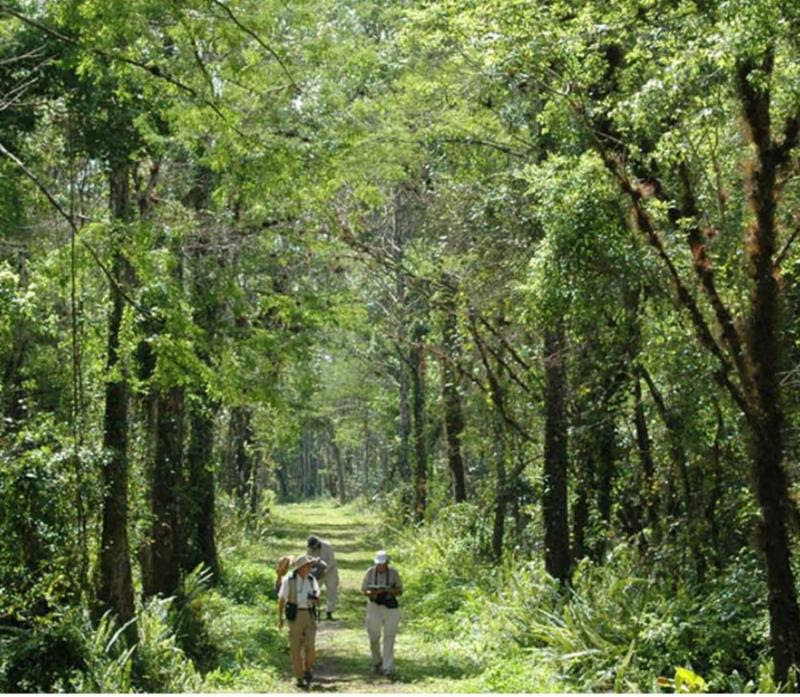
Several miles of trails provide a variety of recreational opportunities for all ages at the CREW Management Area. Click on the image for a larger version.
Fort Myers, FL – Outdoor enthusiasts will have an opportunity next week to provide input and support for the South Florida Water Management District’s (SFWMD) current recreation program at one of Southwest Florida’s premier public lands.
The Water Resources Analysis Coalition’s (WRAC) quarterly Recreational Issues Forum will focus on the Corkscrew Regional Ecosystem Watershed (CREW) Management Area. The CREW area offers several recreational activities, including hiking, bird watching, camping and hunting. The forum will be held:
Day:
Monday, October 22, 2018
Time:
5 p.m.
Place:
SFWMD Fort Myers Service Center
2301 McGregor Blvd.
Fort Myers, FL 33901
SFWMD and its partners – representing environmental groups and governmental agencies – manage CREW for its numerous benefits to water storage and wildlife preservation.
In April, SFWMD completed restoration of 1,000 acres of Southern CREW in Lee County, allowing the area to return to its natural hydrological conditions of periodic inundation. The restoration project benefits the entire Southwest Florida ecosystem and its residents by restoring wetlands and historic sheetflow of water, improving regional flood protection, drainage and increasing water storage and aquifer recharge capability.
On June 14, boardwalk construction ended at Bird Rookery Swamp and the trail re-opened on Friday, June 15.
The replacement of the boardwalk is a multi-year project, funded and completed by the South Florida Water Management District. This year’s work replaced the middle part of the boardwalk. In 2017, one third of the boardwalk, starting from the tram and working towards the parking lot, was replaced.
The new boardwalk sections are built with Azek composite decking, which is expected to withstand the humid, wet conditions present at Bird Rookery Swamp. The final section is expected to be replaced in 2019.
Anne here. Yes, that Anne – the one that answers the Facebook messages at all hours of the day and night, the one that chats you up on the phone when you call to ask me if BRS is open. I want to tell you that it’s open – I do. It breaks my heart to know I’m breaking your heart. And when you are mad- and a lot of you are – I want to give you a cookie and tell you it will be okay. Because it will. We’re all just in Bird Rookery Swamp Withdrawal – all of us, even the staff and volunteers.
Of course you can still call me at the office, or Facebook message me – some of you are becoming quite good friends of mine – but in the meantime, here are a few answers to our Frequently Asked Questions about the closure of Bird Rookery Swamp.
Hello? Is it me you’re looking for?
WHY is Bird Rookery Swamp Closed?
This is an important question, and one we have to address right away. It’s come to our attention thanks to some of the fence-hoppers (we’ll chat about y’all in a hot minute) that the public perception is that the boardwalk is barricaded and big NO ENTRY signs are up because the trails are wet, like they always are this time of year, and we don’t want you to get wet feet.
We love wet feet. And we know our die-hard Bird Rookery Swamp friends do as well.
The trails are wet, just as they always are this time of year – okay, maybe a BIT more wet than usual. But the reason the trail is shut down at the end of the boardwalk is hazardous conditions due to contractors working on the trail to fix washouts.
Working with BIG LOUD DANGEROUS machinery and they can’t see anything around them, so the trail was closed for the safety of all involved.
Why are there so many washouts, and what is a washout?
The trail at Bird Rookery Swamp should not be there.
WHAT?
Bird Rookery Swamp is at the very bottom of the 60,000-acre watershed. And when the area was logged for cypress, the tram was built to hold the railroad, blocking the natural flow of water. Every single year when the water flows south, we have blow-outs on the trail, and we slap a band-aid on (a gravel band-aid) and fill it in, then wait for the next rainy season to blow out different areas.
Add in a hurricane and we’ve got a lot more washouts than usual and some of the old ones became dangerous deep-water crossings. The one by Ida’s pond was waist deep on me (Anne) two weeks after the hurricane and the water was flowing pretty hard as I stood there and tried to trim back part of a tree that fell.
So. We have washouts. We will continue to have washouts. We just had a lot more than normal this rainy season. And all the washouts need to be repaired so you can hike, bike and enjoy the entire loop.
Why is this taking so LONNNNNNNGGGGG?
Water. The trails are wet. The big, heavy machinery will do a lot of damage to the really wet sections, or get stuck. So wet trail conditions are delaying the project. But every week the contractor is checking on the trails, and it is drying up – so we keep our fingers crossed.
You OTTER be fixing these trails!
Why can’t you just open up the first part? It looks fixed.
Remember how I talked about the heavy machinery? Well, it made deep ruts in that first section, and those need to be smoothed out for the safety of our guests and visitors. And, to get that machinery in, the trails need to dry up.
Also – I, or we, the CREW Trust – cannot open or close trails. The South Florida Water Management District manages the lands within the CREW Project, and most of those are public lands (which is why there is no charge to park or visit the trail). We – the CREW Trust- are the non-profit that provides environmental education for all ages on the trails. We also do our best to raise awareness about the watershed by telling people about the trail systems through Facebook and this website. WE cannot open or close the trails – only the District, our partner agency, can do that.
If I can’t go to Bird Rookery Swamp to ride my bike/hike/walk my dog/take photos of awesome wildlife, where can I go?
There are two trail systems off of Corkscrew Road, just a quick fifteen minute drive east of I-75. The CREW Marsh Trails is the only trail system within the CREW Project that is part of the Great Florida Birding Trail, and the Cypress Dome Trails is our least-visited trails BUT has the most active wildlife according to sightings by hikers.
I saw a bear there about two months ago – my first sighting of a bear on one of the CREW Trails.
You can hike, go birding, walk your dog and/or take photos at either trail system. Bikers, head to the Cypress Dome Trails. 100% of the Marsh Trails are clear, thanks to Jessi and a lot of FGCU student volunteers. The Cypress Dome Trails are mostly clear, except for the Wild Coffee Trail, which is the back part of the white trail. CREW Trust staff and volunteers are slowly clearing that by hand and waiting for it to dry up to continue working.
Can I volunteer and help clean up Bird Rookery Swamp so it gets open sooner?
I wish you could. I wish I could. But the District is in charge of this project, so we respect their closure and try to wait patiently.
If you do like to clear trails, please volunteer! We will have trail clean-ups in preparation for the opening of Flint Pen Strand for the public. We also have a great group of volunteers – please fill out an application if you are interested.
What happens if I just hop the fence?
Well, that’s a bad idea. We’ve already been told of one rescue by Collier County deputies of a hiker who hopped the fence and then needed assistance in the back part of the trails. The District also has signs posted that say the trail is closed; FWC Law Enforcement says it is a $50 fine if/when you are caught.
From a purely personal standpoint – we, your friendly staff at the CREW Trust, worry about your safety. Please respect the closure and try to wait patiently for it to re-open so we can see you soon at our guided walks and programs.
The CREW Land and Water Trust has had a spectacular year. More people visited our trails than ever before. Our educational programs were more numerous and reached more people. Additional land was put into preservation. The Southern Critical CREW project was launched. Fundraising was very successful. And, we owe it all to our CREW Trust members and volunteers.
Education is a major part of preserving and protecting the Corkscrew Regional Ecosystem Watershed. This past season, 45,118 visited CREW trails or participated in school field trips, guided walks or seminars. All of these activities are made possible by generous contributions, memberships dues, and fundraising such as the CREW Stanley Hole Golf Tournament and the Annual CREW Concert and Silent Eco-Auction.
We couldn’t carry out our mission without our largest fundraiser, the CREW Concert & Silent Eco-Auction. Over 400 people attended to help us raise over $29,000 for our on-going environmental education programs.This event would not be possible if it wasn’t for our amazing generous sponsors. If you would like to join in on the fun this upcoming year then save the date- February 18, 2017 for the CREW Concert & Silent Eco-Auction. Help us by becoming a sponsor or donating a unique eco-auction item.
The CREW Trust Land Acquisition committee along with Florida Forever assisted the South Florida Water Management District in the purchase of 619.93 acres of land adjacent to Bird Rookery swamp along Immokalee Road in Naples. In addition, the Southern Critical CREW project at Flint Pen Strand began the long process of restoring 4150 acres near the end of Bonita Beach Road (see picture below) . In less than two years, this water restoration project will yield many miles of additional trails and recreational opportunities.
We wouldn’t be able to do all this fantastic work without the help of our CREW Trust volunteers. Our volunteers donated over 3,427 hours of their time this past season. Our volunteers help lead hikes, develop programs, create marketing materials, help remove exotic invasive plants, rebuild boardwalks, and much more. Our members and volunteers make all of these accomplishments possible. The members provide sustainable financial support and our volunteers provide the horsepower to get the job done. Together, our members, volunteers, staff and Trustees are the beating heart of the CREW Trust.
Our annual CREW – Stanley Hole Golf Tournament is always fun, ever entertaining, and a great way to network, meet new people, and help to support CREW’s ongoing Environmental Education programs.
CREW Benefit Golf Tournament 2015
WHEN: October 23, 2015
WHERE: Old Corkscrew Golf Club, 17320 Corkscrew Rd., Estero 33928
TIME: Shotgun Start at 8:30 AM (Registration 7:30 – 8:15 AM)
Entry Fee: $100/player or $400/foursome
Hole Sponsorship: $500
Download the hole sponsor and player registration form below, and please be sure to share it with friends….
SOUTHERN CREW RESTORATION PROJECT CLEARS ANOTHER HURDLE
~Project phase will restore wetlands, provide flood protection and increase water storage~
LEE COUNTY, Fla. – The Florida Department of Environmental Protection has authorized the South Florida Water Management District (SFWMD) to continue the next phase of the Southern Corkscrew Regional Ecosystem Watershed (CREW) Restoration Project. When completed, the project will provide significant benefits to the ecosystem including restoring wetlands and the natural sheetflow of water, improving regional flood protection drainage, increasing water storage and aquifer recharge capability, and reducing the amount of nutrient-rich stormwater reaching the Imperial River and Estero Bay.
“This project exemplifies the commitment of the state of Florida to protecting and restoring the larger south Florida ecosystem,” said DEP Deputy Secretary for Ecosystem Restoration Drew Bartlett. “The department will continue to work closely with our partners to ensure that restoration continues.”
The authorization issued today is for Phase II of the Southern CREW Restoration Project which encompasses 4,150 acres of multiple native plant communities, including hydric pine flatwoods, strand swamps, wet prairies and marshes that have been fragmented by past construction of ditches and roads. These alterations have resulted in restriction of historic sheetflow, artificial water impoundments and flooding, increased pollutant loading to the Imperial River, an Outstanding Florida Water, and disruption of natural wetland functions.
“The project will restore the southwest corner of the larger CREW project,” said SFWMD Governing Boardmember Rick Barber. “The restoration in this particular location creates a vital buffer area between the CREW project and the eastern urban boundary.”
Phase II of the project consists of ditch backfilling, ditch plugging, road degradation and the construction of low water crossings to allow for the re-establishment of hydrologic conditions similar to those present prior to development attempts of the area in the 1960s. The project is expected to restore approximately 437 acres of wetlands. The project’s enhancements are anticipated to encourage the growth and sustainability of native wetland plant species, providing both food and habitat for wildlife.
The Southern CREW Restoration Project is located in Lee County between the Kehl Canal, which is located adjacent to the northern boundary, east of Interstate 75 and north of Bonita Beach Road.
Original Article:http://content.govdelivery.com/accounts/FLDEP/bulletins/10c091b
A: Slash Pine in South Florida lacks data, probably because there is not a local lumber industry.
However, Roy DeLotelle, a researcher for Red-cockaded Woodpecker habitat in Collier County, has collected data on the age of pine trees important for the woodpeckers. It comes from coring pines in the woodpecker’s habitat in Picayune Strand in Collier County.
Slash Pines grow a little larger in the drier pine/palmetto forests (mesic flatwoods) than in the wetter pine/grass forests (hydric flatwoods), and there is a good deal of difference between individual trees. Note the variations between the individual dots and the
“average” line in the graph, so a tree’s diameter in DeLotell’s graph below may not tell the precise age.
In the field, biologists use a different indicator of an “old” pine tree: a flat top shape to the pine canopy.
In DeLotells’ graph of his data, DBH is the Diameter at Breast Height. The R-squared values show how well the line fits the data points. R-squared ranges between 0 and 1 with the higher number showing the line is a good fit for the data.
Slash Pines can easily live past 200 years, and there are many that old in Collier County.
Q: What causes the small brown and yellow patches on healthy plant leaves?
An Alligator Flag leaf by the Bird Rookery Swamp boardwalk protects itself from further damage by isolating an invasive pathogen.
A:
It’s often apoptosis, a term that comes from plant kingdom where the Greek apoptosis originally meant the loss of petals of leaves. Now, it can refer to both the plant and animal kingdoms and is also called Programmed Cell Death (PCD).
Cells in plants and animals can self-destruct when they are no longer needed or if they are damaged. For plants, this achieves and maintains stability within the internal environment when it is dealing with external changes.
Natural PCD (not caused by external factors) includes the timely death of petals after fertilization and the senescence of leaves. Host-controlled PCD is also a means of resistance to pathogens. Cells challenged by pathogens initiate a hypersensitive response, which is a rapid PCD process that is activated in order to inhibit the spread of invading pathogen.
PCD in plants has a number of molecular similarities to animal apoptosis, but it also has differences. The most obvious is the lack of an immune system to remove the pieces of the dead cell.
Greatly simplified, instead of an immune response, an enzyme is activated that destroys the central vacuole (a bubble-like cavity) in the plant cell, which is followed by disintegration of the rest of the cell. This creates a protective, dead “envelope” around the pathogen to limit its spread. This is what may appear on some leaves as a yellow and brown blotch.
Some examples of apoptosis in the animal kingdom include the resorption of the tadpole tail at the time of its metamorphosis into a frog, the removal of tissue between fingers and toes of the fetus as it develops, the elimination of T cells that might otherwise mount an autoimmune attack on the body, and during the pupal stage of insects that undergo a complete metamorphosis, the death of most of the cells of the larva which provide nutrients for the development of the adult structures.
* Over 38,000 visitors to CREW Trails
* Two amazing fundraisers brought in over $30,000
* CREW volunteers donated 3,906 hours
* 4,600 people participated in our environmental education programs
January 2014, the CREW Trust began its 25th anniversary, celebrating 25 years of land conservation and environmental education in southwest Florida. From the kick-off event in frigid cold weather last January to our final #GivingTuesday end-of-year fundraising campaign running through December 31st, this celebration has had something for everyone – a wine & cheese social and a BBQ for CREW members, trail events that included a variety of guided walks about everything from mushrooms to mammals, a geocaching day, a horseback ride through Flint Pen Strand, a guided bicycle ride at Bird Rookery Swamp, a Vitamin N Walk for families, a fabulous 25th anniversary concert featuring the Sarah Hadeka Band and Deb & the Dynamics, and our first #GivingTuesday fundraiser. Thank you to every one of you who volunteered, participated, sponsored, supported, and gave to CREW during 2014, making our 25th anniversary such a success! We look forward to the next 25 years…
Ever wonder what that 5,000-acre marsh that you can see from the overlook at the CREW Marsh trails looks like out in the middle? Take this virtual ride on an airboat through the Corkscrew Marsh, the headwaters to the Corkscrew Regional Ecosystem Watershed (CREW) and you will see.
This is where much of southwest Florida’s drinking water gets stored and cleaned by nature within the watershed and where wading birds nest, limpkins and snail kites forage, and alligators raise their young. Notice the patchwork of sawgrass, open water with water lilies, tree islands, and big beautiful sky! The CREW project team (land managers, biologists) recorded this ride in August of 2014. Video by Tiffany and Dan Thornhill.



 Q: How old are the bigger slash pine trees?

