CREW FWC Biologist Kathleen Smith honored as Resource Manager of the Year

From FWC Press Release 8/15/2018

photo from FWC flickr account


Kathleen Smith, a biologist with the Florida Fish and Wildlife Conservation Commission (FWC), has been honored with the Florida Department of Environmental Protection’s Resource Manager of the Year award for her work at the Corkscrew Regional Ecosystem Watershed Wildlife and Environmental Area in southwest Florida over the past six years.

The award, presented to her at the Governor and Cabinet’s Aug. 14 meeting in Tallahassee, recognizes outstanding resource management achievements by the hundreds of resource managers who protect state properties.

Smith was recognized for her passion and commitment to conserving wildlife while working in partnership with the South Florida Water Management District that co-manages this WEA, which is in Lee and Collier counties. One focus has been work on the federally endangered Florida bonneted bat. Smith has shared 240,000 acoustic bat call signatures she collected, and then analyzed the data used to develop monitoring and permitting protocols for this rare native species.

She also recognizes the CREW WEA is not just important for listed species but is a popular recreational destination. She has worked hard to maintain public access when hydrological restoration projects caused closures to roads and areas within the WEA.

“It is abundantly clear that Kathleen accepted the position of the CREW WEA area biologist with the aim to expand its duties, and to greatly enhance the research, monitoring and restoration of the species and habitats that make CREW WEA such a unique treasure to the region,” said her supervisor Daniel Mitchell, who nominated her for the award. “Kathleen’s impact on conservation goes beyond the footprint of CREW, as she has assisted with conflict wildlife issues in the area involving bears and panthers. She has a great ability to communicate with the public and goes the extra mile – like translating information into both Spanish and Creole languages to communicate better with Farm Workers Village residents in Immokalee on wildlife issues such as beingBearWise.”

“Kathleen possesses all the traits of an exemplary resource manager, including a strong work ethic, leadership ability, tremendous organizational and interpersonal skills, and dedication to going above and beyond her regular job duties,” said Kipp Frohlich, Director of the FWC’s Division of Habitat and Species Management. “We are so proud that she is being recognized for her great work and we are truly fortunate to have her on our FWC team.”

Smith’s work ethic and dedication might have been best exemplified last year when her housing was significantly damaged by Hurricane Irma.

“The hurricane didn’t slow her down one bit,” said her supervisor. “Despite personal hardship, she worked tirelessly on clearing trails, preventing further damage and coordinating repairs at CREW WEA.”

Visit MyFWC.com/Viewing and click on “Wildlife Management Areas” to learn more about the FWC’s WMAs and WEAs throughout the state.

Memorial plaque to honor Dr. David Cooper installed at the Marsh Trails


Our volunteer, teacher and friend, Dr. David R. Cooper, passed away in May. We were, and still are, deeply saddened by the news. Many of us, from staff and volunteers to visitors and members, learned so much from him during walks on the CREW Marsh Trails.

In January, the education fund was renamed the Dr. David R. Cooper Education Fund and Dr. David was honored for his fifteen years of service as a volunteer for the CREW Trust. He retired from leading walks last season but spent many hours sitting at the trailheads, greeting visitors and sharing information about the trails.

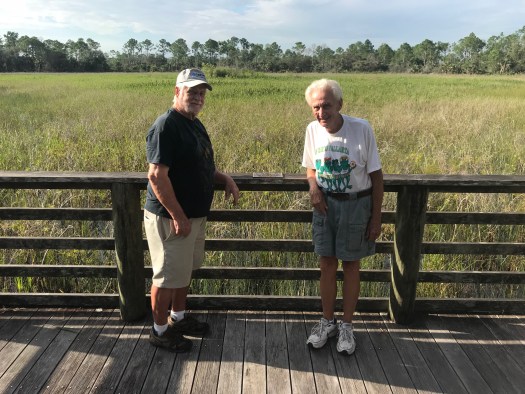
To honor his memory, a plaque was installed on the railing of the seasonal marsh viewing platform. The spot was a stop on almost every one of Dr. David’s tours, where he would point out the ring of pines and then instruct his walkers to look up and watch for red-shouldered hawks.

For those wishing to honor Dr. David, we hope that this spot will offer you a quiet place to remember him and think back on the time spent learning from him on the trails.

Doug Machesney, CREW Trust Trustee, and Jack Wheeler installed the plaque at the seasonal marsh overlook at the CREW Marsh Trails.

2018-2019 Hunting Season starts Saturday

Cypress Dome Trails – hunters should expect wet trail conditions with mud in many areas.


The 2018-2019 hunting season begins Saturday, August 4 with archery season, which ends August 14.

The Cypress Dome Trails and Caracara Prairie Reserve are locations where hunting takes place during hunting season. Signs will be posted at the trailheads to inform other user groups about the current hunting dates. Hunting also takes place within the Flint Pen Strand unit but the trails are not yet complete and the parking lot is not open at this time. Hunting season does not take place on the CREW Marsh Trails or in Bird Rookery Swamp.

There are several quota hunts within the CREW WEA each year :

Archery – August 4-12, 2018

Muzzleloading Gun – September 1-3, 2018

General Gun – November 17-25, 2018 

Small Game Season – December 1-30, 2018

Spring Turkey – March 2-5 and 6-10, 2019

Please check MyFWC.com for updated information during the 2018-2019 season.

Hunting on the CREW Wildlife and Environmental Area (WEA) is regulated by the Florida Fish & Wildlife Conservation Commission (FWC). Hunting is an important management tool, helping to control potentially devastating wild hog populations and maintaining healthy populations of other game species.

For more information about current hunting regulations for CREW, getting quota permits, and season dates, check the Florida Fish and Wildlife Conservation Commission website. To learn more about and sign up for FWC Hunter Safety Courses, visit myfwc.com/hunting/safety-education/courses/.

Trail Conditions 

Information and directions to the CREW Trails

2018-2019 CREW Wildlife and Environmental Area Hunting Brochure


CREW Trust accepting applications for Education Coordinator

Posted July 25, 2018. Application, cover letter, resume and three references due Wednesday, August 1, 2018 by 12 p.m. (noon). 

CREW Land & Water Trust is currently accepting applications for the position of Educaiton Coordinator.

A section from the job description:

“The CREW Trust’s Education Coordinator is responsible for delivering existing education programs, developing new programs, and coordinating and managing volunteers. The Education Coordinator is responsible for engaging program participants and volunteers, imparting to them an understanding of CREW’s natural resources and ecosystem services and cultivating positive attitudes and behavioral changes that help protect CREW and the natural environment of Southwest Florida. This position reports to CREW Trust’s Executive Director.”

For more on this position, please read the full CREW Trust education coordinator job description.

The CREW Land & Water Trust is a 501(c)3 non-profit conservation organization that partners with private businesses and public agencies (including the South Florida Water Management District [SFWMD] and the Florida Fish and Wildlife Conservation Commission [FWC]) to purchase and protect the lands within CREW. CREW Trust’s environmental education and public outreach programs for adults and children are the first introduction many in the community have to CREW. Therefore, the Education Coordinator serves a critically important role in our small non-profit.

Interested applicants should submit an application, cover letter, resume and three references to Brenda Brooks, Executive Director (brenda@crewtrust.org) no later than Wednesday, August 1st at 12 p.m. (noon).

The CREW Trust is an equal opportunity employer and employs without regard to race, color, religion, gender, age, national origin or disabilities in compliance with federal and state laws.

CREW Trust Employment Application

CREW Trust Employment Application – fillable pdf

CREW Trust Education Coordinator Job Description

Applications, cover letters, resumes and references may be submitted electronically to Brenda Brooks, Executive Director (brenda@crewtrust.org) or by mail to CREW Land & Water Trust, 23998 Corkscrew Road, Estero, FL 33928. Mailed documents are still subject to the August 1 deadline.

What you can see this week at Bird Rookery Swamp: Kites, limpkins and calico pennant dragonflies

Volunteer naturalist and CREW Trust citizen scientist Dick Brewer shared his most recent critter count and photos from Bird Rookery Swamp. We hope you find time to hit the trails and maybe catch a few glimpses of these birds, insects, reptiles, amphibians and mammals!

BIRDS
Black-bellied Whistling Duck – 6
Anhinga – 1
Great Egret – 3
Little Blue Heron – 6
Tri-colored Heron – 3
Black-crowned Night Heron – 2
Black Vulture – 8
Turkey Vulture – 9
Swallow-tailed Kite – 3
Red-shouldered Hawk – 8
Limpkin – 8

Mourning Dove – 5
Common Ground Dove – 5
Yellow-billed Cuckoo – 3
Red-bellied Woodpecker – 23
Pileated Woodpecker – 8
Blue Jay – 1
American Crow – 1
Tufted Titmouse – 2
Carolina Wren – 13
Northern Mockingbird – 5
White-eyed Vireo – 10
Northern Cardinal – 20
Common Grackle – 4

BUTTERFLIES
Tiger Swallowtail – 7
Palamedes Swallowtail – 19
Viceroy – 10
Queen – 3
White Peacock – 33
Ruddy Daggerwing – 20
Phaon Crescent – 15
Cloudless Sulphur – 1
Barred Yellow – 1
Brazilian Skipper – 3
Least Skipper – 1
Tropical Checker – 3

DRAGONFLIES
Eastern Pondhawk – 35
Needham’s Skimmer – 3
Blue Dasher – 31
Band-winged Dragonlet – 5
Little Blue Dragonlet – 2
Calico Pennant – 2

HERPS
Alligator – 33
Green Anole – 1
Brown Anole – 15
Pig Frog – 88
Green Treefrog – 3
Southern Leopard Frog – 7
Water Moccasin – 1

MAMMALS
Raccoon – 1

Why is the grass long? Our answers to a few Summer FAQ’s

It’s SUMMMMMMERRRRR!

For us, it’s a much needed break from our season schedule. We’re off scouting new trails, leading a few field trips and heading off on vacations. Summer is slow for us, which can be frustrating for people trying to reach us in the office (where we rarely are) or via email (which we don’t answer on vacation). Because of this, check out our answers to a few summertime Frequently Asked Questions.

Why aren’t there any guided walks scheduled during the summer?

The majority of our visitors are seasonal, but that isn’t the only reason why we offer our guided walks November-April. Those months are also when most of our volunteers are here and we depend on their expertise and generously donated time to lead those hikes. Other reasons are trail conditions and weather. With storms almost every day, lightning is a big deterrent for us scheduling programs during the rainy season. And the trail conditions vary daily and can be wet, muddy, have tall grass – or all of the above.

What are you doing this summer?

Everything we can’t do during season. We are planning next year’s programs, working on reports, and creating new programs for our volunteers, local students and visitors. We’re also doing some major projects. Last summer we walked the first potential Flint Pen Strand trail once a month to monitor how deep the water will get (waist deep for those of you that are curious). This summer we are hard at work re-routing a section of that proposed trail, installing trail markers, improving trail conditions and scouting out additional trails so that everything is ready to go when the South Florida Water Management District opens the trail.

The grass is getting long. When will you mow the trails?

This one is a VERY frequently asked question. We, meaning the CREW Trust staff and volunteers, do not mow the trails. The trails and surrounding land are managed by the South Florida Water Management District. So why is the grass long? There are two main reasons. First, mowing is not a land management priority. Now that some of the rain has come, our land managers are working to complete prescribed burns before the land gets really wet. They are also working on other land management projects that take up their time. The second reason is that, as the water levels rise, the ground gets softer. As we head further into rainy season, the mowers will not be able to get back into the trails without getting stuck. That is the case now in sections of the Cypress Dome Trails, and will be soon in sections of Bird Rookery Swamp. Remember, the land is there for water first, wildlife second, and our enjoyment third.

Bear print

I saw game camera pictures on your website but when I visited I didn’t see any animals. Why is that?

We didn’t pay the animals that day. Just kidding. Kind of. Part of seeing or not seeing animals has to do with the time of day you are on the trails. Early morning or late evening is best, and when you want to hide from the scorching hot inferno of mid-day SWFL summer, the animals do too. The other part is simply luck. We do see more animal tracks during the summer, and part of that could be because we have less people on the trails, or because some of the areas that the animals frequent have too much water so they are looking for dryer areas. Or maybe they finally got our check cashed.

I can’t do (insert favorite thing) on the trails because of trail conditions. When will I be able to do (insert thing)?

Think of this disruption of your favorite thing on the trails (walking disrupted by boot-sucking mud, biking disrupted by long grass) as an opportunitiy to try something you haven’t tried before. Head out with your friend and wade through the Wild Coffee Trail at the Cypress Dome Trails. Slosh along the edge of the marsh at the CREW Marsh Trails and use a field guide to identify all of the blooming wildflowers. Grab a kiddo (or just be a kid at heart) and take photos and identify all the tracks in the mud at any of the trails. Pretty soon rainy season will be over, the water will go down and the mud will dry up and you can go back to your normal favorite trail activities.

Boardwalk Construction complete at Bird Rookery Swamp

On June 14, boardwalk construction ended at Bird Rookery Swamp and the trail re-opened on Friday, June 15.

The replacement of the boardwalk is a multi-year project, funded and completed by the South Florida Water Management District. This year’s work replaced the middle part of the boardwalk. In 2017, one third of the boardwalk, starting from the tram and working towards the parking lot, was replaced.

The new boardwalk sections are built with Azek composite decking, which is expected to withstand the humid, wet conditions present at Bird Rookery Swamp. The final section is expected to be replaced in 2019.

Time to get WET! Check out our tips for taking a walk in the water

During the winter, when the majority of our visitors frequent the CREW Project’s trails, our trail conditions are mainly dry with near-perfect weather each day.

But for those of us who live here year round, we see a completely different side of the trails, with pea-soup-thick humidity, daily afternoon thunderstorms and trails covered in water – the kind there is no tip-toeing around.

Taking that first step into the water can be unnerving. And asking other hikers can either be encouraging or a total nightmare when they send you links to videos of floating masses of fire ants.

(don’t go Google that. REALLY. Don’t. Just trust me.)

We reached out to some of our favorite wet-walk enthusiasts to you help get you prepared and hopefully inspired to take that first step, or dip, on the trails.

Why do you love wet walks?

I love the connection with the energy and life around me. It feels so much different and so much stranger when the water is swirling around my legs. I am in an intimate connection with the swamp. – Brenda Thomas, FGCU and former CREW Trust education coordinator

On a hot and humid summer day, the water is cool and refreshing. – Dick Brewer, CREW Trust volunteer naturalist

Summers are so hot and walking into the water is instantly refreshing. It’s much cooler than you think it will be. -Anne Reed, CREW Trust communications strategist

We might not have mountains in Florida to make you feel humble but a swamp walk sure can! -Jessi Drummond, CREW Trust education coordinator

I love wet walk because you get to see things you don’t see in the dry season and from a totally different perspective. -Janet Bunch, CREW Trust volunteer naturalist

What is one must-have item for wet walks/wet hikes?

A walking stick for balance and for estimating the depth of the water ahead. -Dick Brewer

I recommend long pants. If you are anxious about being in the water, something covering your legs can ease the anxiety. If the water is deep you will likely feel vegetation brushing against your legs and you won’t be able to see what it is. You’ll feel a bit more protected with a layer on your legs. -Brenda Thomas

The must-haves are a bottle of water and a change of clothing (underwear included) or a giant trash bag for the way home! -Janet Bunch

A walking stick. Pro tip – have a way to measure the depth of the water on your walking stick. -Jessi Drummond

Lightweight hiking pants. They don’t soak up the water and then dry relatively quickly. Oh, and make sure you can tuck them into your socks – I have had way too many pine needles creep up my pants during wet walks. -Anne Reed

What is one piece of advice or one tip you have for folks going on their first wet walk?

One important thing to remember about wet walks is to stand up straight. If you are leaning forward and you slip, you’ll go right down. A corollary to this is that you feel with your leading foot and don’t transfer your body weight until you are sure of your footing. Long pants and long sleeves will sae you from a lot of bug misery. -Janet Bunch

The water really isn’t as dirty as it looks, so don’t let the color intimidate you. It’s just brown because of the tannins in the leaves. -Jessi Drummond

Take turns being in front if you go with a group of people. It’s a lot like cycling – you can draft off the lead hiker so pushing the water with your legs doesn’t take as much energy. But if you are drafting, it’s only fair to take your time at the front too because pushing all of that water is hard work! -Anne Reed

Have a towel and a dry set of shoes, and possibly clothes, waiting in the car. -Dick Brewer

Take your time! You need to enjoy every moment you are in the water. Experience the connection and the enrgy and the emotion. Plus, the greatest risk in the water isn’t the things swimming in it – it is you tripping and falling, especially if there are cypress knees hiding under the surface. 

Observations from the Cypress Dome Trails and Caracara Prairie Preserve this week

Volunteer naturalist Dick Brewer donates a lot of time to FWC and the CREW Trust collecting data. From his animal counts on hikes to assisting with Swallow-tailed kite nest monitoring, Dick plays a valuable role as a citizen scientist. This week he spent a long morning hiking the Cypress Dome Trails and Caracara Prairie Preserve. The area is getting quite wet with the week of rain and the marshes are filling up, attracting a lot of wading birds. Check out his observations below from his hike – and this amazing photo he snapped of a Swallow-tailed kite flying back to its nest with a tree frog as a snack.

Tuesday, May 22, 2018

7:10 AM -11:40 AM

72.8º-84.4º, overcast

BIRDS

Black-bellied Whistling Duck – 3

Great Egret – 3

Snowy Egret – 17

Little Blue Heron – 9

Tri-colored Heron – 1

Green Heron – 11

White Ibis – 12

Glossy Ibis – 5

Black Vulture – 25

Swallow-tailed Kite – 34

Red-shouldered Hawk – 14

Short-tailed Hawk (white phase) – 1

Common Gallinule – 7

Limpkin – 1

Killdeer – 4

Mourning Dove – 12

Common Ground Dove – 2

Red-bellied Woodpecker – 19

Pileated Woodpecker – 1

Great-crested Flycatcher – 4

Blue Jay – 5

Carolina Wren – 4

White-eyed Vireo – 4

Pine Warbler – 1

Northern Cardinal – 23

Common Grackle – 3


BUTTERFLIES

Bella Moth – 1

Queen – 1

White Peacock – 1

DRAGONFLIES

Eastern Pondhawk – 7

Carolina Saddlebags – 5

HERPS

Brown Anole – 9

Pig Frog – 7

Florida Cricket Frog – 4

Greenhouse Frog – 2

Green Treefrog – 15

Squirrel Treefrog – 28

Cuban Treefrog – 2

MAMMALS

Raccoon- 1