The CREW Cypress Dome Trails are getting a Crew cut, like a Buzz cut, with a little left on top. Barbershop metaphors aside, the prescribed burn team uses know-how in the field that inspires confidence, which is exactly what you want when it comes to fire in the forest.
Fire lines are dropped on both sides so fire meets fire in the middle and extinguishes itself. So cool, but not literally.
South Florida Water Management District (SFWMD) started this most recent round of shredding and prescribed burns at the Cypress Dome Trails, just as summer temperatures start to rise. Their aim is to mimic historic fire conditions and emphasize growing or lightning season burns (April – August). Though weather conditions and smoke sensitive areas make the timing difficult, the burn crew always use sound judgement and experience on the day of the burn.
Geo-cashers may need to check on this one.
The majority of natural plant communities rely on frequent fires to maintain their vegetative characteristics and biodiversity. Pine cones and Rain Lilies sprout new life and ground dwelling animals, like the gopher tortoise return to these areas in abundance after a fire. Wildfires no longer occur with historical frequency or extent and this has altered natural wildlife and plant community structure and function.
Prescribed fire are important for wildlife and plants because:
reduces the amount of vegetation
opens up space for the native plants to grow and the wildlife to hunt their prey
adds nutrients to the soil
prevents wildfires
Decked with the right gear from boots to helmet, Tiffany and all the burn staff keep a clear line of communication open, even while posing for photos.
All Land Stewardship field staff, which we affectionately call the burn crew, have completed the state certified burn course to ensure fire safety and burning efficiency. If you would like to learn more about the CREW management plan you can read about it here:
Purely by chance a series of college hikes, and second grade field trips, overlapped in the same week, giving this observer a first-hand look at some of the timeless similarities and funny differences between these two age groups.
Second Grade Field Trips
FGCU Colloquium Hike
The bus dismount goes about the same for both groups. Some faces clearly display their inner thoughts, that they actually have no idea they were going for a hike in the middle of a 60,000 acre watershed. Quickly though they are reassured by the guide that they are in good hands and that staff know the way back to the bus. As the students all breath in the fresh air, they generally relax and enjoy the introduction.
As the hike meanders through the diverse yet intertwined ecosystems, personalities start to emerge. This is where it gets interesting.
College students ask questions and make observations that are quite cerebral in nature, where as the second grader is more hands-on and scientific in their approach:
Most second graders want to pick up and touch everything. They get muddy, and when they’re hot, jump in a puddle or pour water on their heads.
Whereas most college students wouldn’t volunteer pick up an insect or touch soil samples, even if it was directly handed to them.
The talented teachers and experienced CREW Trust staff teach the perspective groups about a range of topics from observational details about wildlife and plant species to the benefits of prescribed burns, water quality in Florida aquifers, and what exactly is a Cypress Dome.
The second grader often asks authentic, unprovoked, and funny rhetorical questions about the immediate world around them.
A college student tends to represent a broader knowledge and asks worldly and provocative questions, leading to some interesting discussions with classmates.
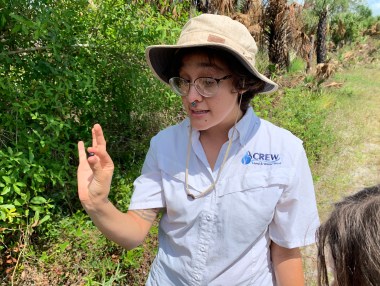
Stephanie Bravo holds a wild blueberry, while expertly warning the students to never eat what you find on the trail.
Guide says: Guess who likes eating these berries?
Students: BEARS!!
Concerned student asks: What do I do if I see a bear?
Guide responds: Well, first of all you probably won’t. But if you do know you’re lucky. Then look big and walk away slowly. You can wait until it leaves and continue your hike. Oh, and hike with a parent or friend.
Florida summer is particularly hot and buggy, but staff points out it’s also the time of year we see water-loving flowers in abundance and say goodbye the youngest Swallow-tailed Kites migrating to South America. The point of all this is to see these things first hand, to push personal boundaries and make a connection with the wild spaces around us.
Second graders will apply their experience in the classroom and start to connect the bigger picture of watersheds and wildlife habitats to conservation projects.
College students may give back, volunteer, or spread the word to friends.
Getting back on the bus, regardless of the age group, students walk away with an awareness of the land and the role they can choose to play through conservation.
This is part 4 of a 6-part series on the Who, What, When, Where, Why and How of the CREW Land & Water Trust.
The CREW Project
It’s pretty often that we get a phone call at our office and someone says, “Where are you located?” or “Where is the trail?”
So let’s cover that today.
WHERE, exactly, is the CREW Land & Water Trust located?
At a field station. A super, top-secret field station, with radiactive sandhill cranes that guard the entrance. (Just kidding about all of that except for the field station part.)
The CREW Trust shares an office with two of our partners in the CREW Project – South Florida Water Management District and Florida Fish & Wildlife Conservation Commission. Because this is a shared office, and we have no trails (really, none – it’s very boring), we use our address for mail only. If you do look us up on Google maps based on our mailing address, we appear to be somewhere in the middle of some strange fields off of Corkscrew Road.
Basically, where WE are isn’t as important as where the CREW Project is.
The CREW Project is a 60,000-acre watershed that spans Lee and Collier Counties. There are four trail systems that are open to the public for various recreation opportunities.
The CREW Trail Systems: A – CREW Marsh Trails; B – Cypress Dome Trails; C – Bird Rookery Swamp; and now a trail has opened in Flint Pen Strand.
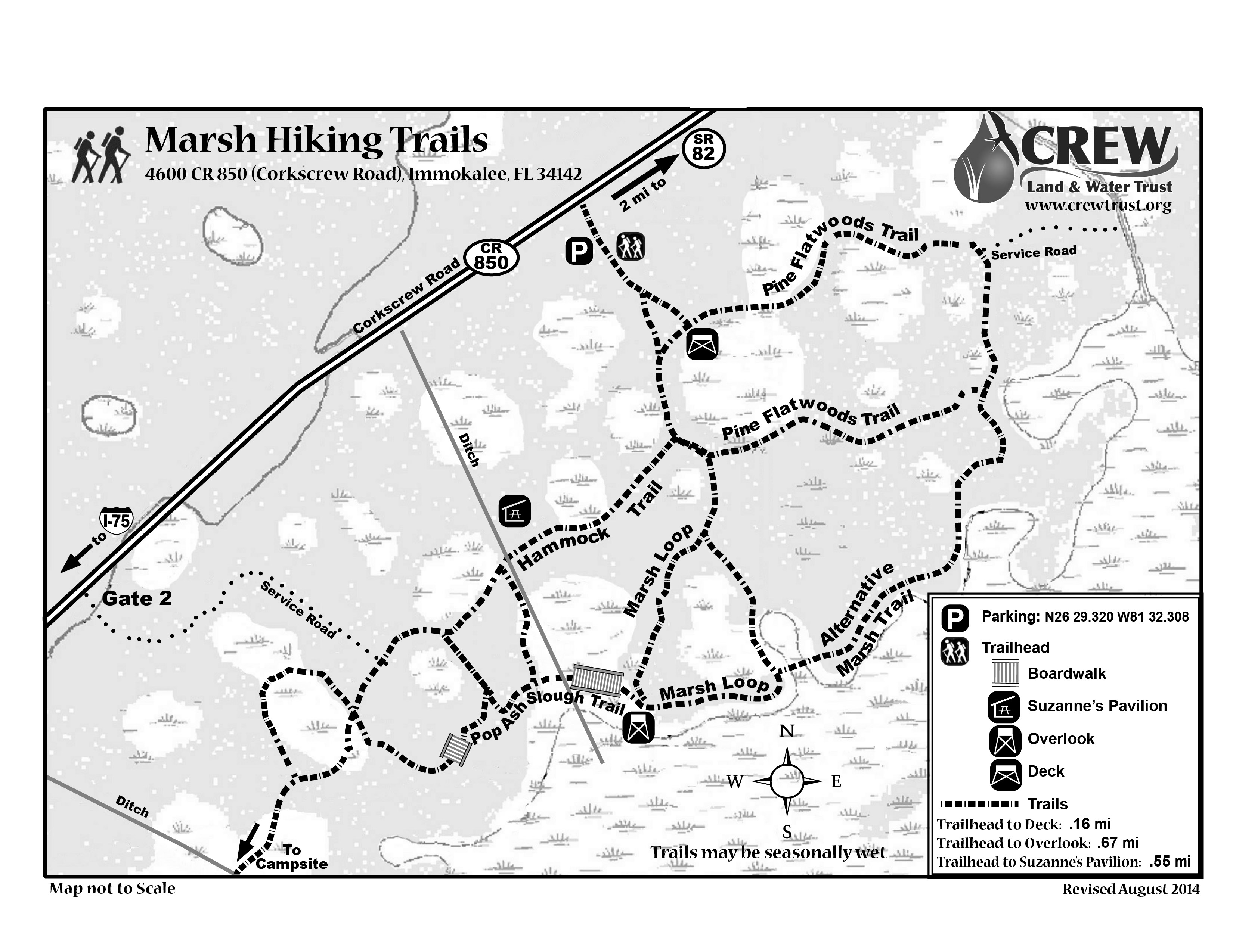
The CREW Marsh Trails (4600 CR 850 (Corkscrew Road), Immokalee, FL 34142 ) were the first trails to open within the CREW Project and feature 5.5 miles of looped trails. The trails are located in Collier County and meander through pine flatwoods, sawgrass marsh, oak hammock and popash slough ecosystems.
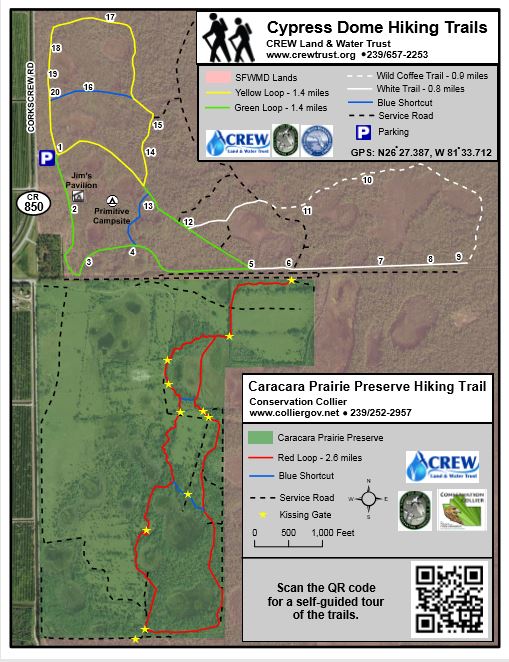
The Cypress Dome Trails & Caracara Prairie Preserve (3980 CR 850 (Corkscrew Road), Immokalee, FL 34142) are located in Collier County near the Lee County border. The Cypress Dome Trails offer 6 miles of looped trails and connect to the Caracara Prairier Preserve, which is owned and managed by Conservation Collier.
Bird Rookery Swamp Trail (1295 Shady Hollow Boulevard, Naples, FL 34120) is an approximately 12 mile trail located in Collier County. The trail features a shell path, short boardwalk and grassy tram – a remnant of its logging history.
The first trail in Flint Pen Strand opened in November 2018 and more are in development. The 1.5-mile red trail offers views of the Kehl Canal along with sections of seasonal marsh and hydric pine.
We actually look forward to the arrival of the Swallow-tailed Kites with something akin to the anticipation of a birthday or holiday.
And when the first birds arrive, the flurry of emails start as people brag about who saw the very first STK of the season.
A swallow-tailed kite soars with a frog in its talons.
We’re crazy about kites at the CREW Project and we know some of you are, too. Here are 10 reasons we love Swallow-Tailed Kites.
1 – Aerodynamics
We could watch kites soar all day long. As one of our volunteers pointed out, the entire design of the bird is aerodynamic and sleek, as if their body is made to slide right through the air. They swoop effortlessly and gracefully to grab prey and it’s while soaring that we are able to easily identify them by their long, forked tail.
2 – Migration patterns
Swallow-tailed kites migrate to Southwest Florida each year from South America to breed. We are their first stop on their winter migration and they normally arrive here in the third or fourth week of February, then gradually later through the rest of Florida, according to the Birds of North America website. Once the adults arrive, they begin gathering nesting material and prepare nests often in the same spot or vicinity as they nested the previous year. Swallow-tailed kites will stay in our area until June or July, and then the adults leave several weeks prior to the juveniles’ departure.
3- Nesting
Swallow-tailed kites are raptors, but they do not have particular strong feet or talons. That’s why they use Spanish moss as nesting material! They have been seen carrying very small, lightweight sticks, but their primary nesting material is Spanish moss. They also nest very high in the “V” of pine trees which make the nests challenging to spot. And, once they chicks hatch, the adults continue to add nesting materials. So, a nest that starts out convex to hold an egg, will eventually become concave as the chick grows!
(Thank you, Kathleen Smith, CREW biologist, for that fun fact)
Swallow-tailed kite carrying Spanish moss for nesting.
4 – Challenge
Everything about the Swallow-tailed kite is challenging! Have you ever tried to get a GOOD PHOTO? Especially of one flying? It’s extremely difficult and we’ve watched plenty of wildlife photographers on the trail gasp in frustration as the birds soar past. And it’s not just capturing the birds on film that is tough – finding the nests is also hard! Because the nests are so high in the trees, and only made sparsely with Spanish moss, they are difficult to find. But, once you have found the nest, you can go back each year and check for activity. For our biologists and volunteer citizen scientists, that challenge is part of the fun of monitoring the kites.
5- Coloration
From the beautiful snow-white head and underbody to the sleek inky wings and back, the kite is a study in contrasting colors. It makes them easily recognizable in the raptor family – for their color and for their forked tail.
6 – The Tail
That gorgeous, v-shaped tail is how all of us easily identify the Swallow-tailed Kite. And, as we inch towards summer, we can tell the juvenilles in flight from the adults because the adults will have longer forked tails than the juvenilles.
7- Feeding time fun
Part of loving raptors is loving the fat that they do raptor stuff – meaning we aren’t upset when we see a bird of prey carrying home dinner. The kites are no exception. They will eat large insects, but remember, they do not have strong feet so they don’t pick up heavy prey. Instead, they mainly eat herps – frogs, anoles and snakes. As a hiker and birder, it can be quite fun to try and puzzle out what they are carrying home to feed their chicks.
8 – Nice Neighbors
One thing that makes them different from other raptors is that the kites will nest near other kites, forming loose neighborhoods (thanks for that name, Kathleen!). That makes it a bit easier for our citizen scientists and the CREW biologists when locating nests. It also makes for easy playdate scheduling (just kidding, birds don’t have playdates).
A kite and chick within the CREW Project.
9 – The CREW Trust Logo
The Swallow-tailed Kite is the bird featured on our logo! We are very proud of the kites, and the fact that the 60,000-acre Corkscrew Regional Ecosystem Watershed is land preserved for water and wildlife and provides habitat for these migratory raptors.
10 – Bringing Friends
The nest monitoring done each year by CREW FWC biologists and volunteers has shown that the numbers of swallow-tailed kites nesting within the 60,000-acres is growing! That’s exciting for us and great news for the birds. You have a really good chance of seeing Swallow-tailed Kites at all four of the CREW Project Trails. They roost around the lake at Bird Rookery Swamp (hike out to the lake, under two miles); they swoop over the red trail at Flint Pen Strand; they have a LOT of nests around the Cypress Dome Trails; and we spot them in the pine flatwoods areas of the CREW Marsh Trails. We hope you’ll celebrate the return of the kites – and their growing population within CREW – by coming out with your friends and exploring the trails in hopes of spotting a kite or two.
special thanks to CREW FWC staff and CREW Trust Volunteers for sharing the photos used in this blogpost.
One of our favorite spring wildflowers is blooming! We spotted – and smelled – the first pawpaws blooming last week along the edges of the flatwoods in the Cypress Dome Trails and the CREW Marsh Trails.
Pawpaws are important for several reasons beyond their beauty and smell. First, they are a host plant for zebra swallowtail butterflies. Second, the fruit they produce is a delicious foodsource for many animals including gopher tortoises.
Want to learn more about CREW wildflowers?
Additional resources to help you find and ID southwest Florida native wildflowers include:
Our volunteer naturalist of many years, Dick Brewer, is well known on our website, blogs and social media for his hours of work as a citizen scientist in the field and for his almost-weekly critter counts.
Now you, too, can complete a critter count! Even if you aren’t quite sure what animals are out there.
Dick has combed through years of observations by himself and others and created two wildlife checklists: one for Bird Rookery Swamp and one for the Cypress Dome Trails. The lists have everything from alligators to skippers, bitterns to bats. Check them out and print a copy for your next visit to the trails!
For us, it’s a much needed break from our season schedule. We’re off scouting new trails, leading a few field trips and heading off on vacations. Summer is slow for us, which can be frustrating for people trying to reach us in the office (where we rarely are) or via email (which we don’t answer on vacation). Because of this, check out our answers to a few summertime Frequently Asked Questions.
Why aren’t there any guided walks scheduled during the summer?
The majority of our visitors are seasonal, but that isn’t the only reason why we offer our guided walks November-April. Those months are also when most of our volunteers are here and we depend on their expertise and generously donated time to lead those hikes. Other reasons are trail conditions and weather. With storms almost every day, lightning is a big deterrent for us scheduling programs during the rainy season. And the trail conditions vary daily and can be wet, muddy, have tall grass – or all of the above.
What are you doing this summer?
Everything we can’t do during season. We are planning next year’s programs, working on reports, and creating new programs for our volunteers, local students and visitors. We’re also doing some major projects. Last summer we walked the first potential Flint Pen Strand trail once a month to monitor how deep the water will get (waist deep for those of you that are curious). This summer we are hard at work re-routing a section of that proposed trail, installing trail markers, improving trail conditions and scouting out additional trails so that everything is ready to go when the South Florida Water Management District opens the trail.
The grass is getting long. When will you mow the trails?
This one is a VERY frequently asked question. We, meaning the CREW Trust staff and volunteers, do not mow the trails. The trails and surrounding land are managed by the South Florida Water Management District. So why is the grass long? There are two main reasons. First, mowing is not a land management priority. Now that some of the rain has come, our land managers are working to complete prescribed burns before the land gets really wet. They are also working on other land management projects that take up their time. The second reason is that, as the water levels rise, the ground gets softer. As we head further into rainy season, the mowers will not be able to get back into the trails without getting stuck. That is the case now in sections of the Cypress Dome Trails, and will be soon in sections of Bird Rookery Swamp. Remember, the land is there for water first, wildlife second, and our enjoyment third.
Bear print
I saw game camera pictures on your website but when I visited I didn’t see any animals. Why is that?
We didn’t pay the animals that day. Just kidding. Kind of. Part of seeing or not seeing animals has to do with the time of day you are on the trails. Early morning or late evening is best, and when you want to hide from the scorching hot inferno of mid-day SWFL summer, the animals do too. The other part is simply luck. We do see more animal tracks during the summer, and part of that could be because we have less people on the trails, or because some of the areas that the animals frequent have too much water so they are looking for dryer areas. Or maybe they finally got our check cashed.
I can’t do (insert favorite thing) on the trails because of trail conditions. When will I be able to do (insert thing)?
Think of this disruption of your favorite thing on the trails (walking disrupted by boot-sucking mud, biking disrupted by long grass) as an opportunitiy to try something you haven’t tried before. Head out with your friend and wade through the Wild Coffee Trail at the Cypress Dome Trails. Slosh along the edge of the marsh at the CREW Marsh Trails and use a field guide to identify all of the blooming wildflowers. Grab a kiddo (or just be a kid at heart) and take photos and identify all the tracks in the mud at any of the trails. Pretty soon rainy season will be over, the water will go down and the mud will dry up and you can go back to your normal favorite trail activities.
Volunteer naturalist Dick Brewer donates a lot of time to FWC and the CREW Trust collecting data. From his animal counts on hikes to assisting with Swallow-tailed kite nest monitoring, Dick plays a valuable role as a citizen scientist. This week he spent a long morning hiking the Cypress Dome Trails and Caracara Prairie Preserve. The area is getting quite wet with the week of rain and the marshes are filling up, attracting a lot of wading birds. Check out his observations below from his hike – and this amazing photo he snapped of a Swallow-tailed kite flying back to its nest with a tree frog as a snack.
Check your wingspan, show off your jumping abilities, learn about backyard birds and so much more at Amazing Animal Abilities on Saturday, April 14, 2018 from 9 a.m.-2 p.m. at the CREW Cypress Dome Trails!
This year’s event will take place in an open field near the trailhead with ample parking for guests. Adults and children can visit 10 stations, experiencing everything from nature-related crafts and geocaching to learning more about local and migratory birds and the wildlife that calls CREW home.
Informative volunteer naturalists will lead small groups on guided nature walks, teaching families about the CREW project, identifying flora and fauna and helping establish a connection between guests and nature.
“My hope for this event is to bring more young families out to the CREW trails,” explained Jessi Drummond, education coordinator for CREW Land & Water Trust. “We want to show them how easy it is to have fun in nature and provide them with ideas and activities they can do at home or while visiting CREW.”
Families are encouraged to register for this free event by visiting crewtrust.org. Cost is $5 per family for non-members; families who are members attend for free.
The CREW Cypress Dome Trails offer six miles of well-marked loop trails through pine flatwoods, oak hammocks, wet prairie, popash slough and cypress domes. The trails are flat and mainly composed of grass and sand. There is no running water at the site and a portable bathroom is available for use.
The CREW Cypress Dome Trails are located at 3980 Corkscrew Road, Immokalee, just 15 minutes east of I-75 near the Estero/Collier County border.