Hiking at CREW: A comparison of Second graders and college-aged students.

Purely by chance a series of college hikes, and second grade field trips, overlapped in the same week, giving this observer a first-hand look at some of the timeless similarities and funny differences between these two age groups.

The bus dismount goes about the same for both groups. Some faces clearly display their inner thoughts, that they actually have no idea they were going for a hike in the middle of a 60,000 acre watershed. Quickly though they are reassured by the guide that they are in good hands and that staff know the way back to the bus. As the students all breath in the fresh air, they generally relax and enjoy the introduction.

As the hike meanders through the diverse yet intertwined ecosystems, personalities start to emerge. This is where it gets interesting.

College students ask questions and make observations that are quite cerebral in nature, where as the second grader is more hands-on and scientific in their approach:

  • Most second graders want to pick up and touch everything. They get muddy, and when they’re hot, jump in a puddle or pour water on their heads. 
  • Whereas most college students wouldn’t volunteer pick up an insect or touch soil samples, even if it was directly handed to them.

The talented teachers and experienced CREW Trust staff teach the perspective groups about a range of topics from observational details about wildlife and plant species to the benefits of prescribed burns, water quality in Florida aquifers, and what exactly is a Cypress Dome. 

  • The second grader often asks authentic, unprovoked, and funny rhetorical questions about the immediate world around them.
  • A college student tends to represent a broader knowledge and asks worldly and provocative questions, leading to some interesting discussions with classmates.
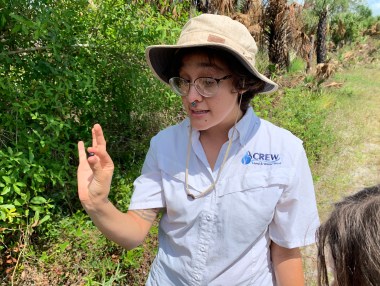
Stephanie Bravo holds a wild blueberry, while expertly warning the students to never eat what you find on the trail.

Guide says: Guess who likes eating these berries?

Students: BEARS!!

Concerned student asks: What do I do if I see a bear?

Guide responds: Well, first of all you probably won’t. But if you do know you’re lucky. Then look big and walk away slowly. You can wait until it leaves and continue your hike. Oh, and hike with a parent or friend.

Florida summer is particularly hot and buggy, but staff points out it’s also the time of year we see water-loving flowers in abundance and say goodbye the youngest Swallow-tailed Kites migrating to South America. The point of all this is to see these things first hand, to push personal boundaries and make a connection with the wild spaces around us. 

  • Second graders will apply their experience in the classroom and start to connect the bigger picture of watersheds and wildlife habitats to conservation projects.
  • College students may give back, volunteer, or spread the word to friends.

Getting back on the bus, regardless of the age group, students walk away with an awareness of the land and the role they can choose to play through conservation.

CREW and You, part 4: WHERE

Map of CREW

This is part 4 of a 6-part series on the Who, What, When, Where, Why and How of the CREW Land & Water Trust.

Map of CREW
The CREW Project

It’s pretty often that we get a phone call at our office and someone says, “Where are you located?” or “Where is the trail?”

So let’s cover that today.

WHERE, exactly, is the CREW Land & Water Trust located?

At a field station. A super, top-secret field station, with radiactive sandhill cranes that guard the entrance. (Just kidding about all of that except for the field station part.)

The CREW Trust shares an office with two of our partners in the CREW Project – South Florida Water Management District and Florida Fish & Wildlife Conservation Commission. Because this is a shared office, and we have no trails (really, none – it’s very boring), we use our address for mail only. If you do look us up on Google maps based on our mailing address, we appear to be somewhere in the middle of some strange fields off of Corkscrew Road.

Basically, where WE are isn’t as important as where the CREW Project is.

The CREW Project is a 60,000-acre watershed that spans Lee and Collier Counties. There are four trail systems that are open to the public for various recreation opportunities.

The CREW Trail Systems: A – CREW Marsh Trails; B – Cypress Dome Trails; C – Bird Rookery Swamp; and now a trail has opened in Flint Pen Strand.

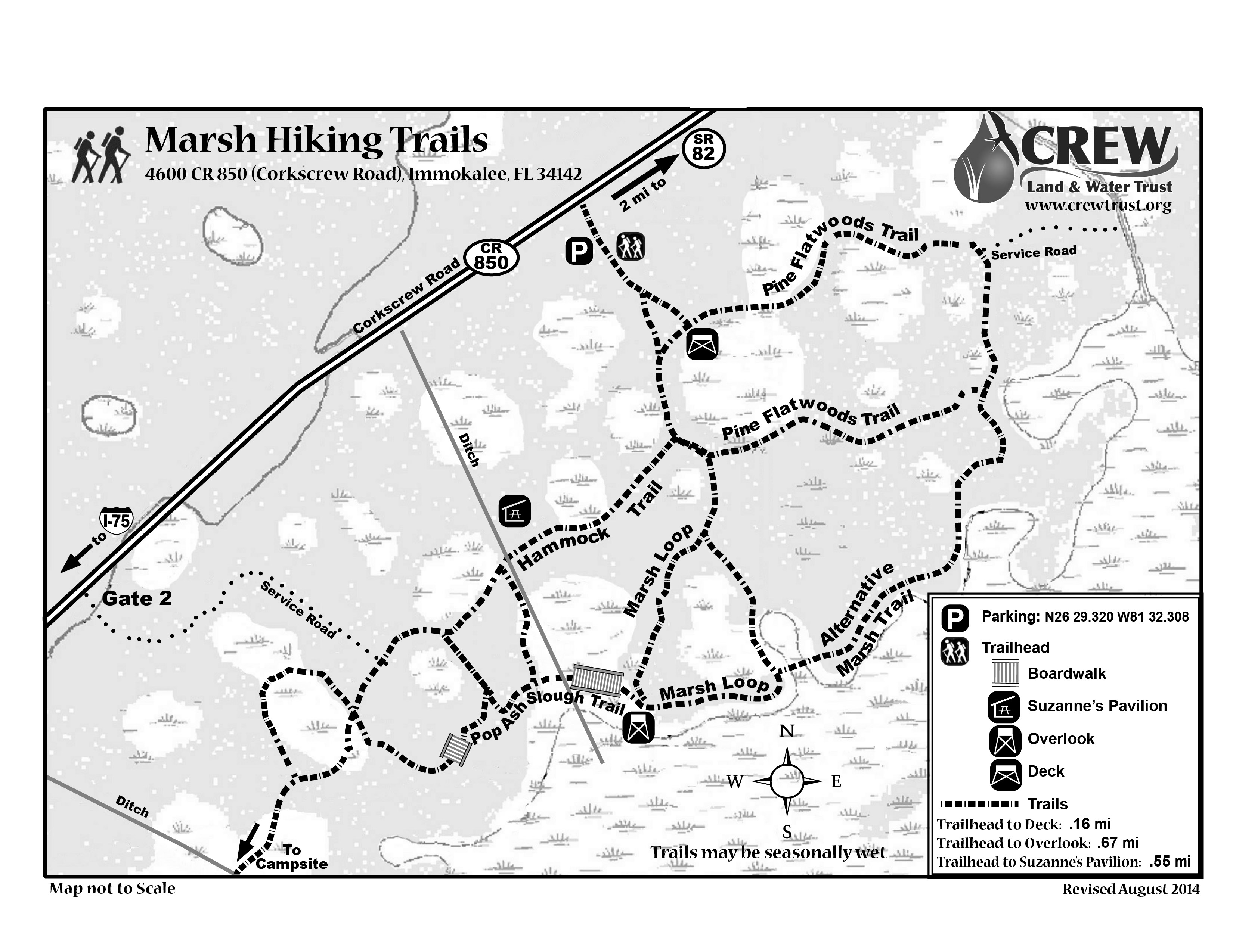
The CREW Marsh Trails (4600 CR 850 (Corkscrew Road), Immokalee, FL 34142 ) were the first trails to open within the CREW Project and feature 5.5 miles of looped trails. The trails are located in Collier County and meander through pine flatwoods, sawgrass marsh, oak hammock and popash slough ecosystems.

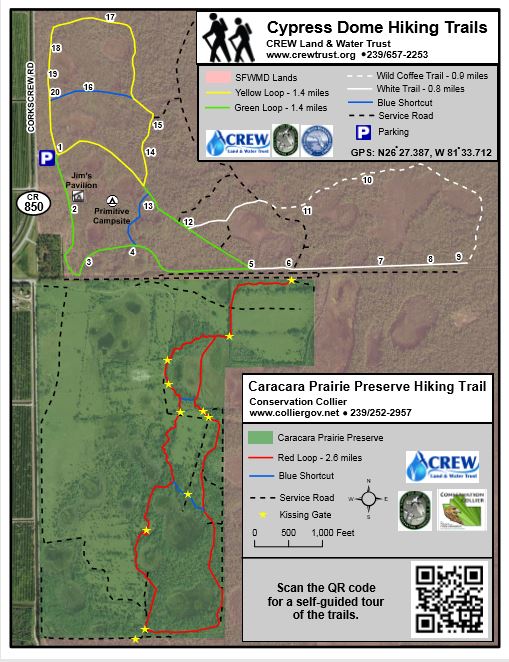
The Cypress Dome Trails & Caracara Prairie Preserve (3980 CR 850 (Corkscrew Road), Immokalee, FL 34142) are located in Collier County near the Lee County border. The Cypress Dome Trails offer 6 miles of looped trails and connect to the Caracara Prairier Preserve, which is owned and managed by Conservation Collier.

Bird Rookery Swamp Trail (1295 Shady Hollow Boulevard, Naples, FL 34120) is an approximately 12 mile trail located in Collier County. The trail features a shell path, short boardwalk and grassy tram – a remnant of its logging history.

The first trail in Flint Pen Strand opened in November 2018 and more are in development. The 1.5-mile red trail offers views of the Kehl Canal along with sections of seasonal marsh and hydric pine.

Tails on Trails: Five tips for hiking with your dog

Piper and Charlotte hiking the Cypress Dome Trails complete with a pack for carrying their hiking supplies.

We love seeing tails wagging out on our trails. The wide paths of the CREW Marsh Trails and Cypress Dome Trails are perfect for exploring with your pooch.

Before you head out for a hike, check out a few of our recommendations to help make your hike a success for you and an enjoyable experience for your pet.

Safety First

For your dog’s safety, he/she must be leashed. We also recommend making sure they walk in the center of the trail. Why?

Fire Ants.

No one wants to accidentally step into a fire ant mound, and the since the ants nest in disturbed areas with a lot of sunshine, the edges of the trail are their preferred nesting spots. Once one ant bites, it releases a pheromone that tells all of the other ants to swarm. It’s difficult enough to brush the furious ants from your own boots/socks/pants so just imagine the impossible task of quickly removing them from your pet’s fur.

Staying in the middle of the trail also helps minimize the chances that your curious pup will encounter any reptilian friends that are sunning on the sides of the trail. And a leashed pet also lets other trail users know that you, the owner, are respectful of everyone out there, including the wildlife.

If you are concerned about mosquitos, please do not use mosquito spray designed for humans. DEET is toxic for dogs and can make them very sick. Instead, opt for a mosquito spray designed for dogs or an at-home mix of essential oils.

We also recommend packing a pet first aid kit in your backpack before heading out for a hike. It should include things like a cold pack, gauze, bandages, tweezers, antiseptic and insect sting relief pads. If you do have a medical emergency on the trails, call 911.

And, after your hike, do a post-hike pet check at the car. We recommend checking your dog’s paws for any debris or wiping their paws with a wet cloth.

Hydration

You aren’t the only one who will get thirsty hiking the trails. Just imagine hiking a mile in a fur coat – that is how hot your pooch is going to get in our glorious sunshine and high humidity and he/she cannot sweat to cool themselves off. Pack water for both yourself AND your pooch and bring along a collapsible water bowl to make drinking easy for your pet.

Worried about carrying everything? Consider purchasing a pack for your dog. There are a lot of options on the market and a good-fitting pack can help your dog share in carrying your supplies.

Also, if you are packing a snack to keep your energy up, pack a snack for your pup as well. Hiking is hard work and everyone, including your dog, needs a break in a shady spot with a tasty snack.

Misty enjoys a rest break in the shade at the Cypress Dome Trails.

Pack out what you bring in – even poop

Ahhhhh, the pet waste debate. Ask any frequent hiker at our trails and they’ll tell you all to often the scat they are identifying so eagerly isn’t from bobcats or panthers – it’s from dogs.

Leaving your pet waste behind isn’t just a nuisance for other hikers who may step in it – it’s also dangerous for wildlife. Dog waste can contain harmful bacteria which can affect wildlife or end up in our water. And, if your dog happens to ingest feces that was left by other dogs on the trail, they can get sick with diseases such as Parvo or parasites including tapeworms.

Take dog waste bags with you and pick up after your pet. You’ll also need to transport that waste to a garbage can, so plan accordingly. Because the CREW trail systems are primitive, they do not have trash cans and all guests are expected to follow the Leave No Trace principles.

Good behavior goes a long way

There are multiple user groups at each trail system, including horses and bikers at the Cypress Dome Trails and birders and photographers at all trails.

If your dog needs to work on their manners, meaning, if they bark a lot and may distrub birders, you may want to head to the trails during off-peak times. Birders and wildlife photographers usually hit the trails very early in the morning so, if you want to avoid any angry glares or shushing noises, head out later in the morning. If your pet doesn’t like crowds, check to see when programs are being offered at the trails and avoid hiking during programming times. And, if you are unsure if hiking is right for your pet, try short walks around the neighborhood and note how they react to other dogs and people. They’ll likely react to people, wildlife and other dogs on the trails the same way so, if they need more time to work with you on manners, take that time before heading out to hike.

And owners, good behavior on your part is key. When you see other hikers, step to the side and guide your dog so they do not venture close to other hikers, who may be leary of dogs or uncomfortable around them. When we all get along on the trails, everyone benefits.

Harriet shows off her excellent hiking skills and good behavior while staying safely in the middle of the trails at the Cypress Dome Trails. Good girl, Harriet, those are some gold-star hiking skills.

Know before you go

Before heading out to the trails, check out the trail maps and descriptions, user groups and trail conditions on our website. Once you arrive at the trails, note your GPS location in case of emergency and take note of any wildlife warning signs.

We suggest taking photos of the snakes that you may encounter on the trails, which are on a poster at the kiosks. We have several venomous snakes that your curious pup may encounter along the sides of the trails or off the trails (but we certainly hope they do not venture off the trail).

It’s also important to note the route you plan to take on a map and make sure that the distance you plan to cover fits the fitness level of yourself and your dog. Short hikes are a great way to start enjoying the trails and slowly build up both your endurance and your dog’s.

Special thanks to Harriet, Misty, Charlotte and Piper for bringing their humans out for a hike! Harriet’s owner, Cheryl, won a private Tails on Trails hike at our 2019 CREW Concert & Silent Eco-Auction.

See what’s flitting around Bird Rookery Swamp this week!

Special thanks to volunteer naturalist Dick Brewer, who regularly visits the CREW trails and compiles wildlife counts. This valuable citizen science is shared with the CREW Trust staff and our FWC biologists and helps give us a glimpse of all the wildlife using the trails.

Needham’s Skimmer, identified and photographed by Dick Brewer


Bird Rookery Swamp

Thursday, March 28 ~~ 7:25 AM – 2:10 PM

temperature: 59.3-77.8º ~~ RH 83.9-44.9%

sky: clear ~~ wind 7-12 mph

BIRDS

Common Gallinule – 1

Double-crested Cormorant – 1

Anhinga – 10

Great Blue Heron – 2

Great Egret – 12

Snowy Egret – 1

Little Blue Heron – 5

Tri-colored Heron – 1

Black-crowned Night Heron – 2

White Ibis – 72

Black Vulture – 3

Turkey Vulture – 4

Swallow-tailed Kite – 7

Red-shouldered Hawk – 23

Belted Kingfisher – 4

Red-bellied Woodpecker – 23

Downy Woodpecker – 3

Pileated Woodpecker – 5

Great-crested Flycatcher – 3

Eastern Phoebe –  1

White-eyed Vireo – 19

Blue Jay – 1

American Crow – 2

Tufted Titmouse – 9

Carolina Wren – 17

House Wren – 1

Blue-gray Gnatcatcher – 2

Gray Catbird – 13

Common Grackle – 9

Palm Warbler –  2

Northern Cardinal – 13

BUTTERFLIES

Palamedes Swallowtail – 3

Tiger Swallowtail – 1

Ruddy Daggerwing – 1

White Peacock – 61

Gulf Fritillary – 1

Phaon Crescent – 1

Tropical Checker – 3

DRAGONFLIES

Eastern Pondhawk – 72

Blue Dasher – 82

Blue Dasher, identified and photographed by Dick Brewer

Needham’s Skimmer – 18

Regal Darner – 3

Halloween Pennant – 1

Slaty Skimmer – 1

REPTILES

Alligator – 41

Brown Anole – 1

Red-bellied Turtle – 3

MAMMALS

White-tailed Deer – 1

10 Reasons we love STKs (Swallow-tailed Kites)

It is one of our favorite times of the year.

We actually look forward to the arrival of the Swallow-tailed Kites with something akin to the anticipation of a birthday or holiday.

And when the first birds arrive, the flurry of emails start as people brag about who saw the very first STK of the season.

A swallow-tailed kite soars with a frog in its talons.

We’re crazy about kites at the CREW Project and we know some of you are, too. Here are 10 reasons we love Swallow-Tailed Kites.

1 – Aerodynamics

We could watch kites soar all day long. As one of our volunteers pointed out, the entire design of the bird is aerodynamic and sleek, as if their body is made to slide right through the air. They swoop effortlessly and gracefully to grab prey and it’s while soaring that we are able to easily identify them by their long, forked tail.

2 – Migration patterns

Swallow-tailed kites migrate to Southwest Florida each year from South America to breed. We are their first stop on their winter migration and they normally arrive here in the third or fourth week of February, then gradually later through the rest of Florida, according to the Birds of North America website. Once the adults arrive, they begin gathering nesting material and prepare nests often in the same spot or vicinity as they nested the previous year. Swallow-tailed kites will stay in our area until June or July, and then the adults leave several weeks prior to the juveniles’ departure.

3- Nesting

Swallow-tailed kites are raptors, but they do not have particular strong feet or talons. That’s why they use Spanish moss as nesting material! They have been seen carrying very small, lightweight sticks, but their primary nesting material is Spanish moss. They also nest very high in the “V” of pine trees which make the nests challenging to spot. And, once they chicks hatch, the adults continue to add nesting materials. So, a nest that starts out convex to hold an egg, will eventually become concave as the chick grows!

(Thank you, Kathleen Smith, CREW biologist, for that fun fact)

Swallow-tailed kite carrying Spanish moss for nesting.

4 – Challenge

Everything about the Swallow-tailed kite is challenging! Have you ever tried to get a GOOD PHOTO? Especially of one flying? It’s extremely difficult and we’ve watched plenty of wildlife photographers on the trail gasp in frustration as the birds soar past. And it’s not just capturing the birds on film that is tough – finding the nests is also hard! Because the nests are so high in the trees, and only made sparsely with Spanish moss, they are difficult to find. But, once you have found the nest, you can go back each year and check for activity. For our biologists and volunteer citizen scientists, that challenge is part of the fun of monitoring the kites.

5- Coloration

From the beautiful snow-white head and underbody to the sleek inky wings and back, the kite is a study in contrasting colors. It makes them easily recognizable in the raptor family – for their color and for their forked tail.

6 – The Tail

That gorgeous, v-shaped tail is how all of us easily identify the Swallow-tailed Kite. And, as we inch towards summer, we can tell the juvenilles in flight from the adults because the adults will have longer forked tails than the juvenilles.

7- Feeding time fun

Part of loving raptors is loving the fat that they do raptor stuff – meaning we aren’t upset when we see a bird of prey carrying home dinner. The kites are no exception. They will eat large insects, but remember, they do not have strong feet so they don’t pick up heavy prey. Instead, they mainly eat herps – frogs, anoles and snakes. As a hiker and birder, it can be quite fun to try and puzzle out what they are carrying home to feed their chicks. 

8 – Nice Neighbors

One thing that makes them different from other raptors is that the kites will nest near other kites, forming loose neighborhoods (thanks for that name, Kathleen!). That makes it a bit easier for our citizen scientists and the CREW biologists when locating nests. It also makes for easy playdate scheduling (just kidding, birds don’t have playdates).

A kite and chick within the CREW Project.

9 – The CREW Trust Logo

The Swallow-tailed Kite is the bird featured on our logo! We are very proud of the kites, and the fact that the 60,000-acre Corkscrew Regional Ecosystem Watershed is land preserved for water and wildlife and provides habitat for these migratory raptors.

10 – Bringing Friends

The nest monitoring done each year by CREW FWC biologists and volunteers has shown that the numbers of swallow-tailed kites nesting within the 60,000-acres is growing! That’s exciting for us and great news for the birds. You have a really good chance of seeing Swallow-tailed Kites at all four of the CREW Project Trails. They roost around the lake at Bird Rookery Swamp (hike out to the lake, under two miles); they swoop over the red trail at Flint Pen Strand; they have a LOT of nests around the Cypress Dome Trails; and we spot them in the pine flatwoods areas of the CREW Marsh Trails. We hope you’ll celebrate the return of the kites – and their growing population within CREW – by coming out with your friends and exploring the trails in hopes of spotting a kite or two.

special thanks to CREW FWC staff and CREW Trust Volunteers for sharing the photos used in this blogpost.

The sweet smell of pawpaws

One of our favorite spring wildflowers is blooming! We spotted – and smelled – the first pawpaws blooming last week along the edges of the flatwoods in the Cypress Dome Trails and the CREW Marsh Trails.

For visitors lucky enough to attend one of the remaining free guided walks at the Marsh Trails with Janet Bunch, you’ll learn all about the pawpaws and likely get nose-close and personal with their sweet scent.

Pawpaws are important for several reasons beyond their beauty and smell. First, they are a host plant for zebra swallowtail butterflies. Second, the fruit they produce is a delicious foodsource for many animals including gopher tortoises.

Want to learn more about CREW wildflowers?

Additional resources to help you find and ID southwest Florida native wildflowers include:

Click HERE for a partial list of wildflowers found at CREW.

Brrrrrrrr! Who is roaming Birdy Rookery Swamp in these wintry conditions?

Too cold to head to the trails? Thinking the animals will be huddling somewhere for warmth?

That is true for many of our reptile friends, but the weekend’s heavy rain combined with the cool temperatures made for a lot of wading birds out and about Monday morning at Bird Rookery Swamp!

CREW Trust volunteer naturalist Dick Brewer braved the elements and sent in his wildlife count from yesterday’s chilly excursion.

Photo credits: Dick Brewer

Bird Rookery Swamp

Monday, January 28, 2019 ~~ 7:20 AM – 1:20 PM

temperature: 47.1-54.0º ~~ RH 84.0-76.8%

sky: overcast ~~ wind 7-10 mph

BIRDS

Muscovy Duck – 1

Double-crested Cormorant – 2

Anhinga – 29

Great Blue Heron – 16

Great Egret – 34

Snowy Egret – 2

Little Blue Heron – 19

Tri-colored Heron –  7

Black-crowned Night Heron – 35

White Ibis – 145

Roseate Spoonbill – 2

Black Vulture – 38

Turkey Vulture – 9

Red-shouldered Hawk – 14

Belted Kingfisher – 5

Red-bellied Woodpecker – 15

Yellow-bellied Sapsucker – 1

Downy Woodpecker – 1

Pileated Woodpecker – 7

Great-crested Flycatcher – 3

Eastern Phoebe –  3

White-eyed Vireo – 9

Blue-headed Vireo – 2

Tufted Titmouse – 3

Carolina Wren – 10

Blue-gray Gnatcatcher – 8

Gray Catbird – 28

Northern Mockingbird – 1

American Goldfinch – 1

Common Grackle – 11

Black-and-white Warbler – 1

Common Yellowthroat – 10

Palm Warbler –  19

Northern Cardinal – 9

Painted Bunting – 3

HERPS

Alligator –  7

MAMMALS

Gray Squirrel – 2

River Otter – 2

Raccoon – 5

White-tailed Deer – 1

Know before you go: Holiday Hiking

Looking for some vitamin D therapy this holiday week? The trails are waiting and wild Florida is happy to see you!

But before you slip on those flip flops (please no) and head out to one of the CREW Trails, check out a few of the things you might want to know before you go. It will save you the pain of fire ant bites if you DO opt for flip flops (again, please please please no).

For trail conditions, click here.

CREW Marsh Trails

Address: 4600 CR 850 (Corkscrew Road), Immokalee, FL 34142

Hours: Open every day, one hour before sunrise to one hour after sunset

Cost: Free; donations accepted

Facilities: Port-o-potty in parking lot; no trash cans – please pack it in, and pack it out

Miles of trails: 5.5 combined miles of looped trails

Wear: Closed-toe shoes, socks; pants advised if grass is high (as of 12/24/2018 grass is only high along Alternative Marsh trail)

Pack: Water, bug spray (if desired), snack

Safety: Fire ants do nest in disturbed areas along the edges of the trails, so please walk in the middle of the trails.

Can’t Miss Spot: Head out to the Observation Tower, which overlooks the 5,000-acre sawgrass marsh. The marsh is a key part of the watershed and helps filter the water that eventually ends up in the aquifer (and then, in your glass!)

Notes: Do not trust Google maps! Instead, follow these directions:

From Naples/Bonita Springs/S. Fort Myers: Travel  I-75 N to exit 123 (Corkscrew Rd.).  Go 18 miles east on Corkscrew Rd.  You will pass the CREW Cypress Dome Trails.  Go another 4 miles and you will see the CREW Marsh Trails on your right.  Look for the brown road signs.

From N Ft. Myers/Charlotte County/Lehigh Acres: travel I-75 to exit 138 (the ML King/S.R. 82 exit).  Travel east on S.Rr 82 toward Immokalee for 20 miles.  Watch for a small blue C.R. 850 sign, then turn right on C.R. 850 (Corkscrew Rd.).  The Marsh Trails are apporximately 2 miles down the road on your left.  Look for the brown road signs.

Trail Map:

Cypress Dome Trails and Caracara Prairie Preserve

Address: 3980 CR 850 (Corkscrew Road), Immokalee, FL 34142

Hours: Open every day, one hour before sunrise to one hour after sunset

Cost: Free; donations accepted

Facilities: Port-o-potty located close to parking lot on the beginning of the green loop (head toward Jim’s Pavillion)

Miles of trails: The Cypress Dome Trails offer six combined miles of looped trails and connects to Caracara Prairie Preserve, which is owned and managed by Conservation Collier.

Wear: Closed-toe shoes, socks and long pants recommended, especially as there may be muddy conditions in the middle of the Wild Coffee Trail (the farthest part of the white trail).

Pack: Water, snacks, bug spray. Bring extra water if you plan on heading out to Caracara Prairie Preserve as well.

Safety: December is small game hunting season and there are hunters on the property; hunting is monitored by FWC. Fire ants nest in distrubed areas along the sides of the trails, so walking in the middle of the trail is advised.

Can’t Miss Spot: Head out on the green trail (turn right from the trailhead) and it will wind around, past the pavillion, and then meet up with the blue trail (a shortcut). This is marker 4 on the map, and in front of you will be a beautiful Cypress Dome. It is almost dry this time of year, and you can see the water level marks on the bark. Take a photo of yourself or a family member next to the cypress tree so you can see how high the water gets in that area during rainy season!

Notes: Again, don’t trust Google Maps. Follow these directions:

From Naples/Bonita Springs/S. Fort Myers – Travel I-75 N to exit 123 (Corkscrew Rd.). Travel 14 miles east on Corkscrew Rd. The Cypress Dome Trails will be on your right just past a big curve to the left (north). Look for the brown trail signs.

From N Ft. Myers/Charlotte Co./Lehigh Acres: Travel I-75 to exit 138 (the ML King/S.R. 82 exit). Turn left (east) off the ramp. Travel 20 miles toward Immokalee (east) on S.R. 82. Turn right on C.R. 850 (Corkscrew Rd.). You will pass the CREW Marsh Trails at the 2-mile mark. Continue for 4 more miles. The Cypress Dome Trails will be on your left. Look for the brown road signs.

Trail Map:

Flint Pen Strand Trails

Address: 15970 Bonita Beach Road, Bonita Springs, FL 34135

Hours: Open every day, one hour before sunrise to one hour after sunset

Cost: Free; donations accepted

Facilities: One port-o-potty located in the parking lot. No trash cans; pack it in, pack it out.

Miles of trails:  At this early stage, there is one trail open – the Billy G. Cobb Memorial Trail (red trail). It is approximately 1.5 miles long with a blue shortcut trail.

Wear: Closed-toe shoes, socks. Long pants if grass is long but at this time the grass should be short.

Pack: Water, bug spray.

Safety: This trail is not flat and has a lot of terrain changes. Fire ants are a hazard as they like to nest in disturbed areas along the trail.

Can’t Miss Spot: The Melaleuca ghost forest, an area of invasive trees that were treated years ago and are now dead. This area shows what happens when you remove the invasives and allow the land to heal itself, and you will spot young slash pine that are growing and will eventually help this spot return to a hydric pine flatwood.

Notes: Park in the parking lot (and not along the side of Vincent Road). Stick to the marked trails at this time, as some of the surrounding area is privately owned.

Trail Map:

Bird Rookery Swamp Trails

Address: 1295 Shady Hollow Boulevard, Naples, FL 34120

Hours: Open every day, one hour before sunrise to one hour past sunset

Cost: Free; donations accepted

Facilities: Two port-o-potties in the parking lot; no trash cans – pack it in, pack it out

Miles of trails: One almost-13-mile loop. There are no shortcuts back to the parking lot, nor are there any vehicles to come get you if you go out too far and are too tired to walk back.

Wear: Closed-toe shoes, socks, bug spray.

Pack: Snacks and plenty of water, especially if you are going to do the full loop. The swamp is quite humid and you can get dehydrated quickly on a warm day.

Safety: Turn around before you feel tired. This is very important at this trail system, as we have had people head out too far, then decide they cannot walk back to the parking lot – and their only option is to call 911.

Also, this trail is home to numerous alligators. Read all alligator safety signs – you will pass several in the parking lot. Remember this is their home, and you are a visitor. Turn around and go the other way if an alligator is on the path. You may not throw rocks or harass the alligators; if you see someone doing this, call FWC law enforcement.

The walking of dogs/pets is NOT recommended at this trail due to the presence of alligators.

Can’t Miss Spot: The lake at the culvert, just past the boardwalk. You may see alligators, great white egrets, herons, roseate spoonbills and the occasional limpkin feeding in the water.

Notes: Please read all signs and safety information. For first time visitors, a short, easy walk is to head out to the short boardwalk, walk to the first pond, then turn around and head back. This will be around a mile and you will see cypress trees, red maple, wildflowers, ferns, air plants, migratory song birds, herons and more.

Trail Map:


BRS sign

Check out what you might see at Bird Rookery Swamp this week!

Long-time CREW Trust volunteer naturalist Dick Brewer is a treasure-trove of information and brilliant citizen scientist. This week’s critter count includes a chicken turtle, almost 30 red-bellied woodpeckers and a great photo of two crested caracaras. Interested in making your own critter count during your next hike? Print out Dick’s BIRD ROOKERY SWAMP Wildlife Checklist and take it with you!
Bird Rookery Swamp

Wednesday, December 19 ~~ 7:05 AM – 1:00 PM

temperature: 54.0-76.0º ~~ RH 85.5-60.5%

sky: sun early, clouds late ~~ wind: calm at start, then 8-12 mph

BIRDS

Wood Duck – 2

Double-crested Cormorant – 5

Anhinga – 28

Great Blue Heron – 11

Great Egret – 10

Snowy Egret – 3

Little Blue Heron – 7

Tri-colored Heron – 3

Cattle Egret – 1

Green Heron – 4

Black-crowned Night Heron – 11

White Ibis – 22

Roseate Spoonbill – 1

Wood Stork – 2

Black Vulture – 12

Turkey Vulture – 26

Osprey – 1

Red-shouldered Hawk – 14

Crested Caracara – 2

American Kestrel – 1

Common Gallinule – 1

Killdeer – 5

Mourning Dove – 2

Barred Owl – 2

Belted Kingfisher – 8

Red-bellied Woodpecker – 28

Yellow-bellied Sapsucker – 4

Downy Woodpecker – 1

Pileated Woodpecker – 8

Great-crested Flycatcher – 1

Eastern Phoebe –  7

Carolina Wren – 13

House Wren – 1

Blue Jay – 1

Blue-gray Gnatcatcher – 21

Northern Mockingbird – 2

Gray Catbird – 21

Common Yellowthroat – 1

Palm Warbler – 5

Pine Warbler – 1

Northern Cardinal – 4

Common Grackle – 77

BUTTERFLIES

White Peacock – 21

Phaon Crescent – 1

Barred Yellow – 16

Tropical Checker – 1

HERPS

Alligator – 11

Brown Anole – 1

Banded Water Snake – 1

Red-bellied Turtle – 5

Florida Chicken Turtle – 2

MAMMALS

River Otter – 2

Raccoon – 1

Let CREW help YOU with your holiday gift ideas

If you are searching for the perfect gift idea for the nature-minded people in your life, we’re here to help!

Whether you’re looking for something for the new-to-nature person in your life or the trail veteran, check out a few of our recommendations.

For the New Birder

The Bird Watching Answer Book: Everything you need to know to enjoy birds in your backyard and beyond (Cornell Lab of Ornithology)

“That is a really cute stocking-stuffer kind of book,” said volunteer Barbara Centola. “It is the kind of book you would put on your nightstand and read a couple of pages at night.” She purchased one and is planning on giving it to a friend who has shown interest in birding.

For the sentimental hiker

“I love a good walking stick,” said Brenda Brooks, executive director. “And I love to collect hiking medallions to remind me of where I’ve been. It’s an inexpensive way to remember your hike.”

CREW Hiking Medallions (available for Bird Rookery Swamp, CREW Marsh Trails and Cypress Dome Trails ($5 each; limited quantities for local pick-up only; email anne@crewtrust.org)

For the Trail Runner

Goodr Sunglasses

Tired of glasses that fall off your face when you’re out on a run – or even when you’re clearing Caesar weed? These no-slip, no-bounce glasses are the real deal and trail tested by Anne (hence the Caesar weed reference). And with frame names like “Frank’s Llama Land Ditty” and “Orange you glad I didn’t say banana?” they give the gift of a good chuckle, too.

For the four-legged hiker

“I love the water bottles with the drinking tray attached,” said Anne Reed, mom of two dogs, Brady (10.5 year old lab) and Sheila (2 year old chihuahua). “My dogs think it’s fun and it is easier than me carrying an extra water bottle and collapsible bowl in my pack.”

KONG H2O Stainless Steel Dog Water Bottle

For the Fun-Loving CREW Trust Friend

Stuff those stockings with tickets to the 2019 CREW Concert Under the Stars! You’ll be giving the gift of a fabulous night out with live music, great food, craft beer from Momentum Brewhouse and our very unique silent eco-auction! AND, most importantly, supporting our Dr. David R. Cooper Education fund.

2019 CREW Concert Under the Stars tickets

For the inquisitive walker

We joke that there are two types of hikers – point to point hikers, who go go go; and those that move inches in an hour. Sometimes those exist all in the same family! This book is great for the slow-moving hiker who stops to take pictures of panther scat (ANNE) and for the speedy hiker who needs to stop and smell the paw-paw.

The Lost Art of Reading Nature’s Signs

For the “I Don’t Know What I want” friend

Take them on a hike! Gift wrap this coupon for a free hike and then take your friend out on one of the CREW Trust trails. Whether you spend the hike identifying wildflowers, searching the sky for Caracaras, or just catching up, time spent together is the best gift of all. The trails are open every day, sunrise to sunset. Feel free to print one of these fun gift cards and use it to schedule time out in nature with your friends and family! Oh, and if you want to give the gift of a guided walk, register yourself and a friend for one of our upcoming free guided walks.