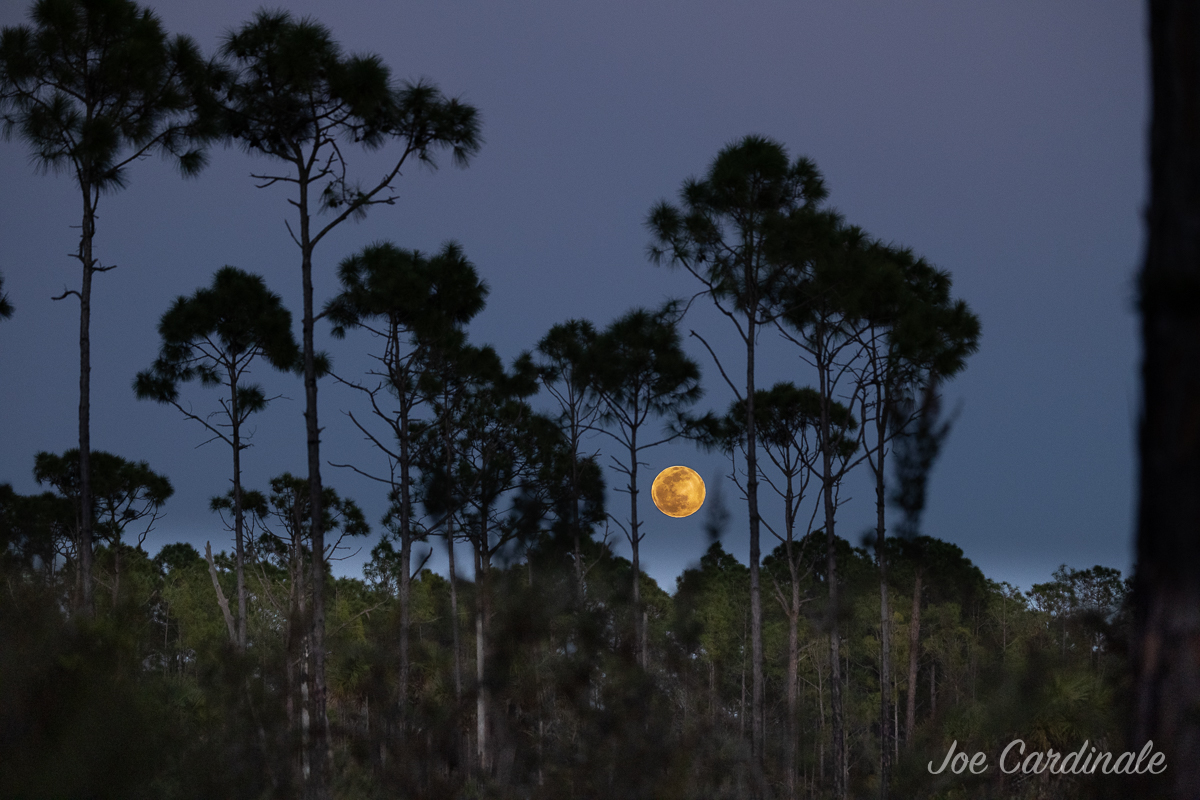
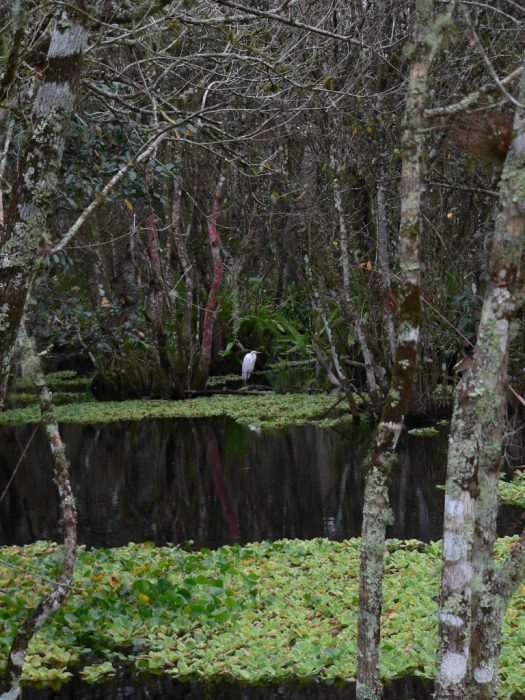
As the water dries down at CREW’s Flint Pen Strand trails, an abundance of wading birds have become regular visitors to the lakes. You can access the lakes two different ways: by hiking from the Main Parking lot or parking in the smaller Lakes Parking lot adjacent to the lakes. If you want to see these birds arrive early for sunrise or later for sunset. Take your time approaching these flighty hunters and you will be rewarded with views perfect for unbelievable photographs. For some inspiration, take a look through this collection from CREW Trust volunteer, Bill Zaino’s recent photos capturing White Pelicans, Roseate Spoonbills, Woodstorks, Tricolored Herons, Great Egrets, Snowy Egrets, Limpkins and Greater Yellowlegs .
Written by Allison Vincent, communications director
Starting a new job can be challenging. The first year of work is like an anthropological research project, studying the behaviors of a faraway culture. Many things are ordinary; check email, print labels, write blog posts etc.. but some things are exciting and new, like hiking down long trails alone early in the morning.
I’ve never really hiked alone and I find the experience makes me feel both mindful and vigilant. I can’t tell you the number of times I’ve frozen mid-step to over-analyze a crooked stick down the trail from me to make sure it’s not a snake. In fact this has happened enough times that I’ve taken to calling them snake sticks, out of respect. Before moving on, I should add that I like snakes but didn’t come across quite so many of them in previous position.
Snake stick versus actual snake
These wriggly wandering sticks have done more than stop me in my tracks. They’ve helped me realize that my overactive imagination has resulted in many animal misidentifications. For my first few weeks at CREW whenever I would simultaneously see a shadowy figure in the palmettos and hear the crunchy noise of foot-steps I’d automatically assume it was a bear or panther too close for my comfort. There’s been more than one instance when I’ve started whistling or said something original like, “Hey, Bear! Or whatever you are, I’m walking here”.
Thankfully, with time on the trails during these purposeful work-hikes I’ve come to accept many of my false assumptions about wildlife. Now I expertly breeze past snake sticks without a missed step and huff at shadowy palmetto bushes. I know where to look for the wispy pink flag that marks the entrance to check the water gauge, a regular job detail during the rainy season. I carefully move the oak tree limbs aside to find the single-file path that wanders through tall grasses to find a post that marks the water depth and I think, ‘This is an awesome job’.
Suggested Tweet: In fall #Florida #bears are more active. @MyFWC reminds people to be BearWise https://content.govdelivery.com/accounts/FLFFWCC/bulletins/25e18bb
Bears are more active in the fall
The Florida Fish and Wildlife Conservation Commission (FWC) is reminding people to help prevent conflicts with bears by securing garbage and other items that might attract these animals.
In the fall, Florida black bears begin preparing for the winter by consuming extra calories to pack on fat. During this time, they will eat anything that’s convenient and feeding on garbage provides more calories and less effort than foraging in the woods.
By securing your trash and other food attractants, you can help keep both people and bears safe.
To keep bears wild and away from your home, follow these simple tips:
It is illegal in Florida to intentionally feed bears or leave out food or garbage that will attract bears and cause human-bear conflicts. If you see or suspect someone is feeding or attracting bears, please call the FWC’s Wildlife Alert Hotline at 888-404-FWCC (3922).
You also can help people and bears stay safe by remembering to watch for bears while driving. This time of year, bears are traveling across more roads in search of food, which results in more vehicle-bear collisions. The FWC advises drivers to be aware of their surroundings as they drive in bear country, especially around dusk and dawn, and when there is forest on both sides of the road. The FWC works with Florida Department of Transportation to post bear crossing signs in areas that receive particularly high levels of vehicle-bear collisions and plan locations for wildlife underpasses to allow bears and other animals to cross safely under roadways. To learn more about how to keep people and bears safe on Florida roadways, see the “Vehicle Collisions with Bears” video at the “Brochures and Videos” section of MyFWC.com/Bear.
We know you’re excited for this season of programs and we can’t wait to share all the incredible hikes, bikes and talks with you. Register for something different every month or make visiting the CREW trails a part of your regular schedule with the weekly guided walks. Pop-up hikes and programs may be added when trail and weather conditions are right! Stay up-to-date on our website, CREWTrust.org.
Registration for our 2019-2020 programs will open on Tuesday, September 3rd to CREW Trust Members. Non-member registration will open one week later on Tuesday, September 10th. You must be a current CREW Trust member to register during our first week, so please make sure your membership is up to date or join today online at crewtrust.org/become-a-member/.
Strolling Science Seminars
Our scholarly walks for ages 18 and older are always a hit and sell-out quickly! This year we have four programs scheduled and may add more as schedules allow.
December 6: Florida Panthers– with Ashlee O’Connor
January 18: Strange Plants in a Strange Land– Join Anne Reed, writer, storyteller and CREW Trust volunteer naturalist for a scholarly walk and talk on the history of our beautiful, pesky and sometimes deadly invasive species.
February 7: Herpetology- with Shane Johnson
March 6: Nature by Any Other Name– with Dr. billY Gunnels
Strolling Science Seminar 2019
Specialty Walks
October 12: Fall Wildflower Walk– Join Brenda Thomas for a stroll along the trails where you’ll see the bounty of Florida’s fall wildflowers! And, if you’re lucky, it might be pine lily time.
January 24: Birding with Brian Beckner of Native Bird Boxes. These sessions are for everyone from serious birders to beginners.
April 14: Spring Wildflower Walk- Springtime means a new rush of color on the trails! Participants will stroll through the CREW Marsh Trails with Roger Hammer, author of several wildflower books including The Complete Guide to Florida Wildflowers.
April 18: GeoCache Day- Milla and Pete will be hosting a day of Geocaching at the Cypress Dome Trail for everyone to come and explore the outdoors!
photo by Bill Zaino at Flint Pen Strand
Free Guided Walks
Our free guided walks schedule has changed this year and walks will be offered on select dates.
2020 CREW Concert Under The Stars & Silent Eco Auction: February 29, from 5-9 p.m. featuring the High Voltage Band at Riverside Park in Bonita Springs. Sponsorship options and tickets available on our website, CREWTrust.org.
Registration for members opens on September 3; for non-members on September 10. All programs require registration; visit eventbrite.com after registration opens. CREW Trust members will receive an email on September 3 when registration opens.
All CREW Trails closed for Hurricane Dorian until further notice.
CREW trails are temporarily closed due to emergency conditions from Hurricane Dorian. The Temporary closure of South Florida Water Management District managed lands is in effect until further notice.
SFWMD Order No. 2019-052-DAO
Effective: August 30, 2019, 5:00 p.m.
40E-& F.A.C. Public Use Rule
South Florida Water Management District
Good Morning,
Bottom Line:
Hurricane Dorian is forecast to be a major hurricane as it approaches the Florida Peninsula late this weekend into early next week
Overview:
▪ Potential for an EXTREME Hurricane Wind & Water Event for parts of the Florida Peninsula ▪ This is a serious and life-threatening situation
▪ Small changes to the forecast can mean big differences in impacts at any given location
Any Questions: If you have any specific questions or want additional coordination please give us a call 305-229-4525
The CREW Cypress Dome Trails are getting a Crew cut, like a Buzz cut, with a little left on top. Barbershop metaphors aside, the prescribed burn team uses know-how in the field that inspires confidence, which is exactly what you want when it comes to fire in the forest.
Fire lines are dropped on both sides so fire meets fire in the middle and extinguishes itself. So cool, but not literally.
South Florida Water Management District (SFWMD) started this most recent round of shredding and prescribed burns at the Cypress Dome Trails, just as summer temperatures start to rise. Their aim is to mimic historic fire conditions and emphasize growing or lightning season burns (April – August). Though weather conditions and smoke sensitive areas make the timing difficult, the burn crew always use sound judgement and experience on the day of the burn.
Geo-cashers may need to check on this one.
The majority of natural plant communities rely on frequent fires to maintain their vegetative characteristics and biodiversity. Pine cones and Rain Lilies sprout new life and ground dwelling animals, like the gopher tortoise return to these areas in abundance after a fire. Wildfires no longer occur with historical frequency or extent and this has altered natural wildlife and plant community structure and function.
Prescribed fire are important for wildlife and plants because:
reduces the amount of vegetation
opens up space for the native plants to grow and the wildlife to hunt their prey
adds nutrients to the soil
prevents wildfires
Decked with the right gear from boots to helmet, Tiffany and all the burn staff keep a clear line of communication open, even while posing for photos.
All Land Stewardship field staff, which we affectionately call the burn crew, have completed the state certified burn course to ensure fire safety and burning efficiency. If you would like to learn more about the CREW management plan you can read about it here:
Purely by chance a series of college hikes, and second grade field trips, overlapped in the same week, giving this observer a first-hand look at some of the timeless similarities and funny differences between these two age groups.
Second Grade Field Trips
FGCU Colloquium Hike
The bus dismount goes about the same for both groups. Some faces clearly display their inner thoughts, that they actually have no idea they were going for a hike in the middle of a 60,000 acre watershed. Quickly though they are reassured by the guide that they are in good hands and that staff know the way back to the bus. As the students all breath in the fresh air, they generally relax and enjoy the introduction.
As the hike meanders through the diverse yet intertwined ecosystems, personalities start to emerge. This is where it gets interesting.
College students ask questions and make observations that are quite cerebral in nature, where as the second grader is more hands-on and scientific in their approach:
Most second graders want to pick up and touch everything. They get muddy, and when they’re hot, jump in a puddle or pour water on their heads.
Whereas most college students wouldn’t volunteer pick up an insect or touch soil samples, even if it was directly handed to them.
The talented teachers and experienced CREW Trust staff teach the perspective groups about a range of topics from observational details about wildlife and plant species to the benefits of prescribed burns, water quality in Florida aquifers, and what exactly is a Cypress Dome.
The second grader often asks authentic, unprovoked, and funny rhetorical questions about the immediate world around them.
A college student tends to represent a broader knowledge and asks worldly and provocative questions, leading to some interesting discussions with classmates.
Stephanie Bravo holds a wild blueberry, while expertly warning the students to never eat what you find on the trail.
Guide says: Guess who likes eating these berries?
Students: BEARS!!
Concerned student asks: What do I do if I see a bear?
Guide responds: Well, first of all you probably won’t. But if you do know you’re lucky. Then look big and walk away slowly. You can wait until it leaves and continue your hike. Oh, and hike with a parent or friend.
Florida summer is particularly hot and buggy, but staff points out it’s also the time of year we see water-loving flowers in abundance and say goodbye the youngest Swallow-tailed Kites migrating to South America. The point of all this is to see these things first hand, to push personal boundaries and make a connection with the wild spaces around us.
Second graders will apply their experience in the classroom and start to connect the bigger picture of watersheds and wildlife habitats to conservation projects.
College students may give back, volunteer, or spread the word to friends.
Getting back on the bus, regardless of the age group, students walk away with an awareness of the land and the role they can choose to play through conservation.
This is part 4 of a 6-part series on the Who, What, When, Where, Why and How of the CREW Land & Water Trust.
The CREW Project
It’s pretty often that we get a phone call at our office and someone says, “Where are you located?” or “Where is the trail?”
So let’s cover that today.
WHERE, exactly, is the CREW Land & Water Trust located?
At a field station. A super, top-secret field station, with radiactive sandhill cranes that guard the entrance. (Just kidding about all of that except for the field station part.)
The CREW Trust shares an office with two of our partners in the CREW Project – South Florida Water Management District and Florida Fish & Wildlife Conservation Commission. Because this is a shared office, and we have no trails (really, none – it’s very boring), we use our address for mail only. If you do look us up on Google maps based on our mailing address, we appear to be somewhere in the middle of some strange fields off of Corkscrew Road.
Basically, where WE are isn’t as important as where the CREW Project is.
The CREW Project is a 60,000-acre watershed that spans Lee and Collier Counties. There are four trail systems that are open to the public for various recreation opportunities.
The CREW Trail Systems: A – CREW Marsh Trails; B – Cypress Dome Trails; C – Bird Rookery Swamp; and now a trail has opened in Flint Pen Strand.
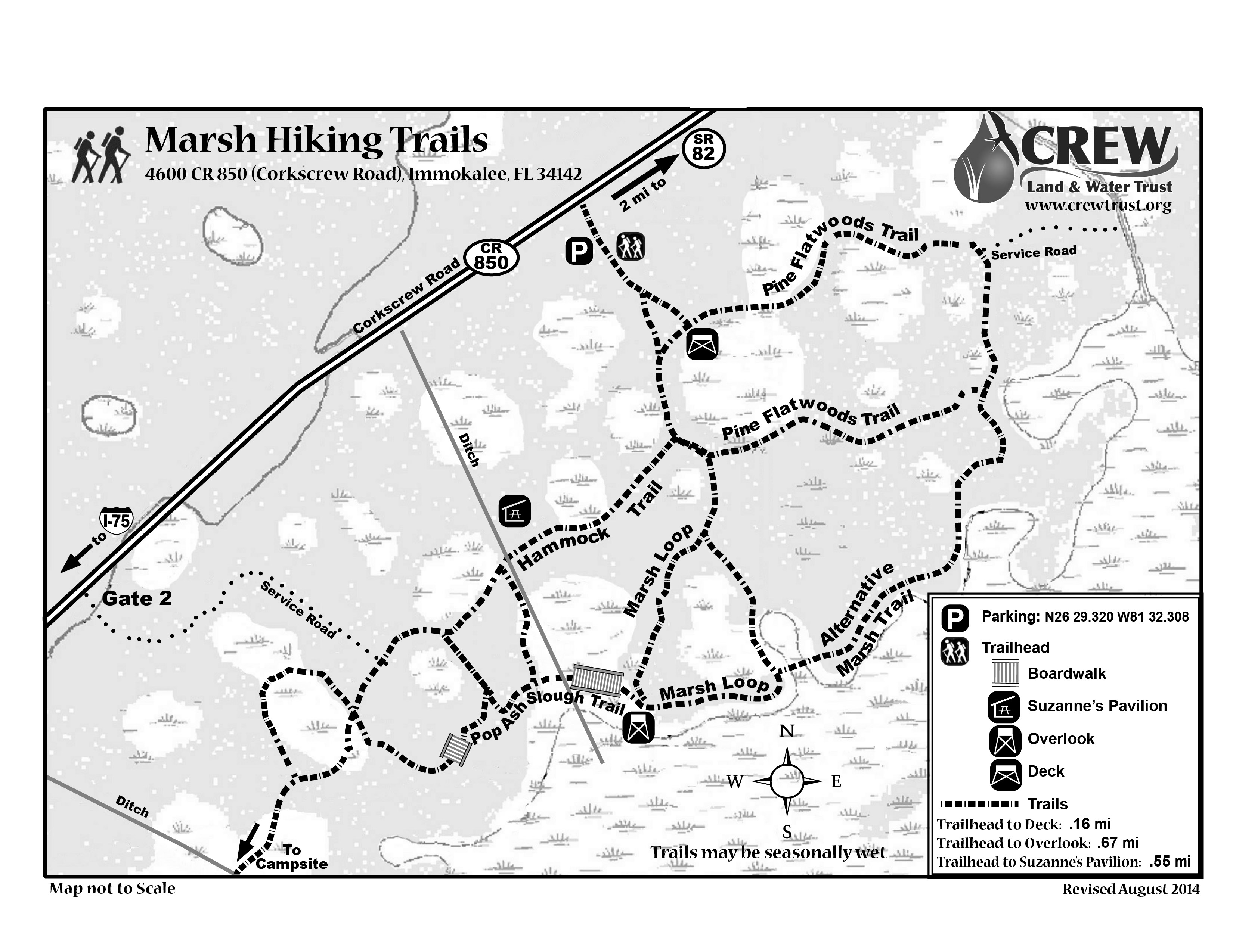
The CREW Marsh Trails (4600 CR 850 (Corkscrew Road), Immokalee, FL 34142 ) were the first trails to open within the CREW Project and feature 5.5 miles of looped trails. The trails are located in Collier County and meander through pine flatwoods, sawgrass marsh, oak hammock and popash slough ecosystems.
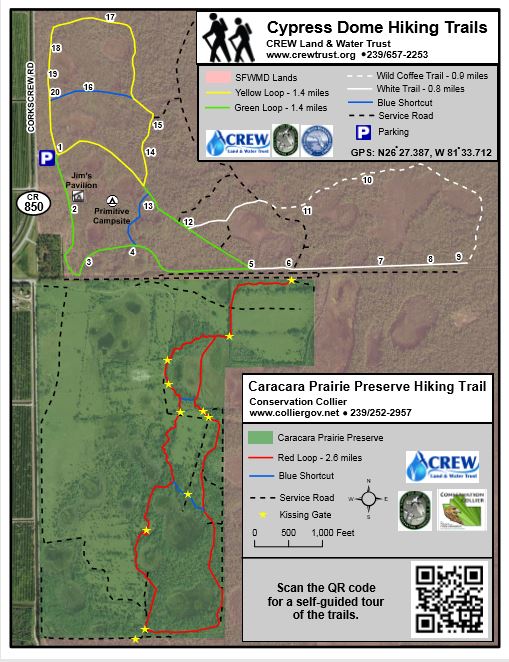
The Cypress Dome Trails & Caracara Prairie Preserve (3980 CR 850 (Corkscrew Road), Immokalee, FL 34142) are located in Collier County near the Lee County border. The Cypress Dome Trails offer 6 miles of looped trails and connect to the Caracara Prairier Preserve, which is owned and managed by Conservation Collier.
Bird Rookery Swamp Trail (1295 Shady Hollow Boulevard, Naples, FL 34120) is an approximately 12 mile trail located in Collier County. The trail features a shell path, short boardwalk and grassy tram – a remnant of its logging history.
The first trail in Flint Pen Strand opened in November 2018 and more are in development. The 1.5-mile red trail offers views of the Kehl Canal along with sections of seasonal marsh and hydric pine.
As our weather turns warmer and rainy season is on the horizon, I find myself reflecting on this past season.
This year the CREW Trust celebrates its 30th anniversary. So much has been accomplished in that time frame, with much more yet to be completed. Of the 60,000-acres within the borders of the watershed, almost 55,000-acres within the Corkscrew Regoinal Ecosystem Watershed (CREW) have been acquired. We continue to pursue our mission of preserving and protecting water, our most valuable natural resource, through working with our partners, specifically Lee County’s Conservation 20/20 program and Collier County’s Conservation Collier.
Education is a key component of ensuring that generations today and those that follow will connect with the land and the wildlife within the CREW Project borders and understand the value of the watershed. We are thankful for the visitors, residents, schools and CREW Trust members who participated in this season’s programs and visited the four trail systems.
This season saw the opening of the fourth and final CREW Project trail system – Flint Pen Strand. Our volunteers have worked for several years to create and mark the first two trails and continue to work on additional trails. Our Board of Trustees have been key players in this process through their work behind the scenes to assist the CREW Trust and our partners in making this exceptional area open to the public.
I have spent time over the last few weeks exploring the yellow loop in Flint Pen Strand. As I stood amidst the dwarf cypress and blooming bladderwort north of Kehl Canal, I thought of my dear friend Jim Goodwin and the hours he put into making Flint Pen Strand a reality. There is no other place in CREW like it, and I’m thankful to our volunteers, members, Board of Trustees and friends who have helped open this fourth trail system so we can all share in the beauty of the watershed.
Summer is our time to plan for next season, and I look forward to seeing you on the trails and thank you for continuing to support the CREW Trust and share in the remarkable beauty that is the CREW Project.
This is part 1 of a 6-part series on the Who, What, When, Where, Why and Hows of CREW and the CREW Trust.
When we first meet people, whether it’s visitors, new members, new volunteers or residents, introducing ourselves (explaining who we are) can be confusing.
It’s not an easy answer.
For example, when you introduce yourself, you say “Hi, my name is Blankity Blank, and I’m a rockstar astrophysicist who enjoys entomology.”
(Also, if that is you, let’s be friends as soon as possible)
But when we, the CREW Trust meet someone knew, explaining who we are can take five minutes – and that’s the short version.
Most people check out within the first two sentences – once they realize we’re going to say a lot of really long words, some of which may be new, like “aquifer recharge” and, well, honestly even what CREW stands for trips people up.
So let’s break it down into WHO exactly we are, and how that relates to CREW.
CREW
The acronym stands for the Corkscrew Regional Ecosytem Watershed, which is a 60,000-acrew watershed that spans Lee and Collier counties in Southwest Florida.
(we will get into the WHAT of the watershed in our next post)
So, CREW is the name for the land. (super short version of the definition)
The CREW Project
We sometimes refer to the entire 60,000-acres as the CREW Project, because CREW involves multiple agencies.
Those agencies include the South Florida Water Management District (SFWMD), Florida Fish & Wildlife Conservation Commission (FWC), Conservation Collier, Conservation 20/20 and the CREW Land & Water Trust. Corkscrew Audubon Sanctuary is also within the borders of the CREW Project.
CREW Land & Water Trust (CREW Trust)
We, the CREW Land & Water Trust, are the non-profit agency attached to the CREW Project.
We help with funding and land acquisition and provide environmental education at the four trail systems within the CREW Project – the CREW Marsh Trails, Cypress Dome Trails, Bird Rookery Swamp and Flint Pen Strand.
The CREW Trust is often confused with CREW (as in, the names are used interchangeably) but we try to stress that we are part of the multi-agency project and NOT the land owners, land managers, biologists, law enforcement… we are helpers within the CREW Project.
We are ultimately tasked with helping each person we meet learn about WHAT CREW is (and what you can do at the trails), WHERE it is located (along with the trails), WHEN the project started and its timeline, WHY it’s important to protect the watershed, and HOW the public can help.